Global crude oil producers are stepping up drilling activity as shifting energy demand and price swings reshape the market outlook for 2025.
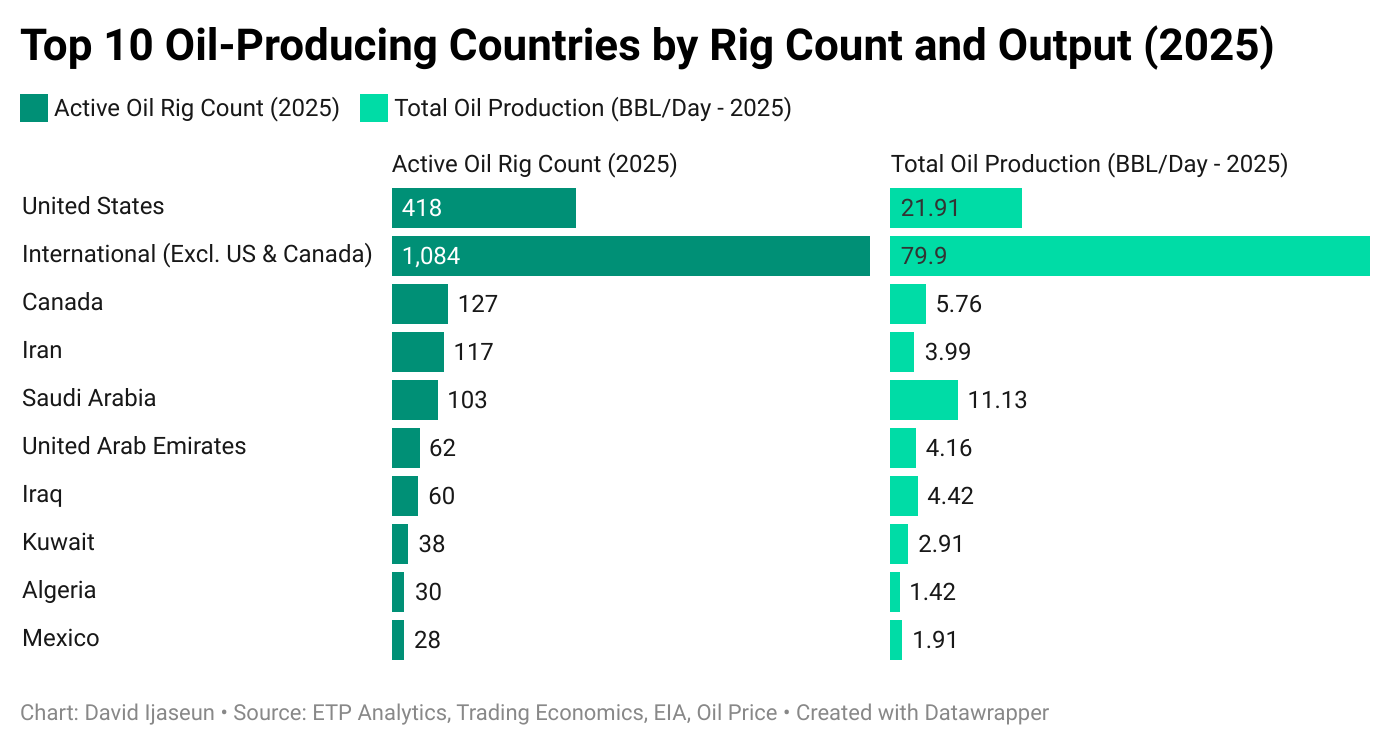
Data garnered by ETP Analytics shows that the United States had the highest oil rig counts and an expanding production capacity.
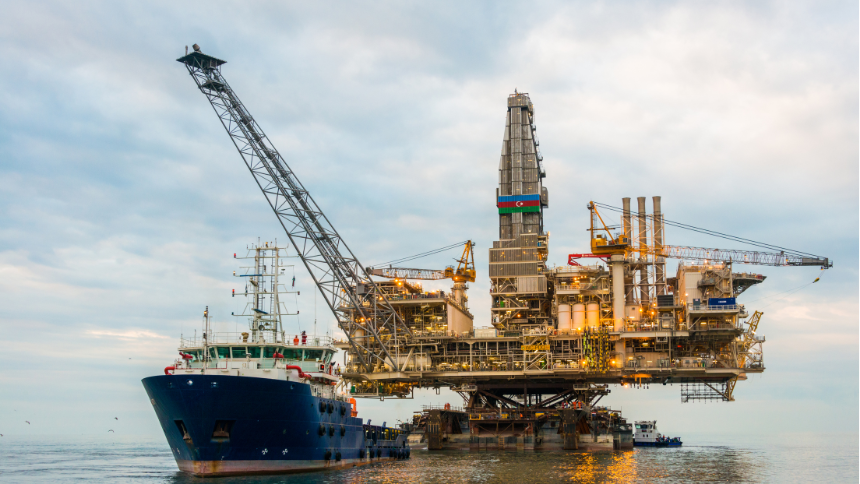
An oil rig, the structure and machinery used to drill wells and extract crude oil from beneath the earth’s surface, serves as a key barometer of exploration and production health. The more rigs in operation, the greater the signal of future output growth.
United States:
The United States continues to lead the world, with around 418 active oil rigs as of October 2025. Its total production, based on the most recent comprehensive data from 2023, stands at about 21.91 million barrels per day, including crude oil and other liquids. Driven largely by shale fields such as the Permian Basin, U.S. crude oil production capacity is expected to reach approximately 13.69 million barrels per day this year.
International (excluding U.S. + Canada)
Beyond North America, the rest of the world collectively operates about 1,084 active rigs as of September 2025, producing nearly 79.9 million barrels per day based on 2023 data. This international figure is dominated by non-OPEC producers such as Russia and China, along with major OPEC members across the Middle East and Africa.
Canada
Canada maintains about 127 active rigs, with total oil production averaging 5.76 million barrels per day. Most of its drilling happens in Alberta’s oil sands, where activity often fluctuates due to weather and environmental regulations.


Iran
Iran follows closely with 117 rigs and a daily output near four million barrels. Despite ongoing international sanctions, Tehran has intensified domestic drilling to maintain and expand production.
Saudi Arabia
Saudi Arabia remains one of the world’s most influential producers, operating 103 active rigs as of September 2025. With an output of roughly 11.13 million barrels per day and a spare capacity of up to 3.5 million barrels per day, the kingdom continues to act as OPEC’s balancing force, capable of adjusting supply to influence prices.
The United Arab Emirates
The United Arab Emirates is also expanding rapidly, with 62 active rigs and a production level of about 4.16 million barrels per day. The UAE recently secured an OPEC+ quota increase, targeting a production capacity above 4.2 million barrels per day in the near term.
Iraq
Iraq’s production capacity continues to grow with 60 rigs and an output of about 4.42 million barrels daily. As the holder of the world’s fifth-largest proven oil reserves, Iraq’s rising rig activity signals its intention to expand exports further.
Kuwait
Kuwait, another key OPEC member, records 38 active rigs and a steady output of 2.91 million barrels per day, maintaining its position as a stable supplier.
Algeria
Across North Africa, Algeria runs around 30 active rigs and produces roughly 1.415 million barrels daily. Its 2025 OPEC+ crude oil quota stands at just under one million barrels per day, reflecting efforts to offset declining field productivity.
Mexico
Mexico closes the top ten with 28 rigs and a production level near 1.9 million barrels per day, focusing equally on crude oil and natural gas as it aims to strengthen domestic energy security.
The global picture highlights several trends, notably, rig counts are not the same as production capacity, but they often move together. A high rig count typically signals potential output growth, though factors like sanctions, field maturity, and investment cycles can alter results.
Nations such as the United States and Saudi Arabia hold large spare capacity, serving as the stabilisers of the oil market. Emerging producers, including Iraq and the UAE, are expanding aggressively, suggesting new supply could enter the market and ease price pressures.
Read more on Oil prices slip to five-month low as US-China tensions, supply fears frow