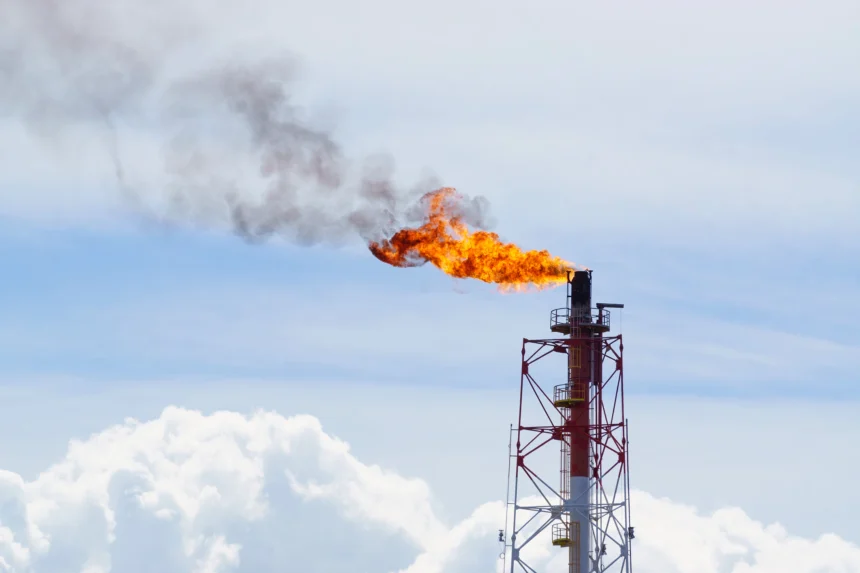
Saudi Arabia Long Relies On Crude Burn
Saudi Arabia has long relied on crude burn—the direct combustion of crude oil in power stations and industrial plants—to meet its domestic electricity demand, which stands at approximately 171 terawatt-hours (TWh). This practice has been a cornerstone of the kingdom’s energy strategy for decades.
New analysis from Rystad Energy reveals that the imminent launch of the Jafurah shale gas field, the world’s largest unconventional gas project slated for production in 2025, could revolutionise Saudi Arabia’s energy landscape.
By harnessing Jafurah’s unconventional gas reserves, the kingdom could replace up to 350,000 barrels per day (bpd) of crude oil used for power generation by 2030. This shift would not only reduce domestic oil consumption but also unlock substantial volumes of crude and refined products for export, bolstering Saudi Arabia’s dominance in global energy markets.
The Jafurah initiative is central to Saudi Arabia’s Vision 2030 economic reforms, aiming to expand gas production by 60% compared to 2021 levels and diversify the energy mix. Transitioning to natural gas and renewables for electricity will diminish reliance on crude oil. With a three-phase rollout and over $100 billion in investments over the next decade, the project is poised to make Saudi Arabia the world’s third-largest shale gas producer.


Strategically situated near Aramco’s Uthmaniyah gas-processing facility, Jafurah capitalises on existing infrastructure, minimising the need for expensive long-distance pipelines. This proximity ensures cost-effective logistics and streamlined operations.
The Uthmaniyah plant’s advanced infrastructure will play a pivotal role in processing Jafurah’s output, efficiently separating natural gas liquids (NGL), ethane, condensate, and other byproducts. This integration maximises the field’s profitability and aligns with Saudi Arabia’s goals of optimising resource value under its ambitious energy transition plans.
“Saudi Arabia is stepping up investment in natural gas as a cleaner, lower-carbon alternative to oil and coal. This strategic pivot, alongside the OPEC+ decision to cap Aramco’s oil production at 12 million barrels per day by 2027, is designed to support price stability while increasing domestic gas consumption.
“Output is projected to climb to 13 billion cubic feet per day (Bcfd) by 2030, setting the stage for a major expansion in gas supply”
Pankaj Srivastava, Senior Vice President, Commodities Markets – Oil
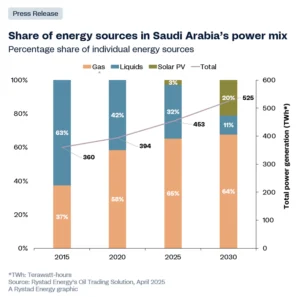
As the Jafurah gas field approaches maturity, it is expected to offset crude burn by 35,000 barrels per day in 2025, gradually increasing to 350,000 barrels by 2030, freeing up volumes that would otherwise be used in power generation.
This shift comes at a critical time, as oil product demand in Saudi Arabia is projected to rise by approximately 100,000 bpd between now and 2030, largely driven by increasing consumption of gasoline and diesel.
However, domestic demand is not expected to be the key driver of Saudi crude growth in the coming years. Instead, the kingdom will likely pivot toward maximizing crude and refined product exports, aligning its strategy with evolving market dynamics and price expectations.
On the domestic front, the economics of fuel switching continue to favor gas over crude for power generation. Domestic natural gas is priced at roughly $2 to $2.5 per million British thermal units and Arab Light crude currently trades at above $70 per barrel. Because of these favorable economics, gas-fired plants—especially high-efficiency combined-cycle units—can now operate at up to 60% efficiency, compared to around 30% for crude-fired systems.
This results in operational costs that are six to eight times lower per kilowatt-hour. These cost advantages underpin Saudi Arabia’s strategy to replace crude with gas in its power mix, enabling the kingdom to redirect more crude toward export markets and strengthen fiscal returns.
By Rystad Energy. The Energy Time