



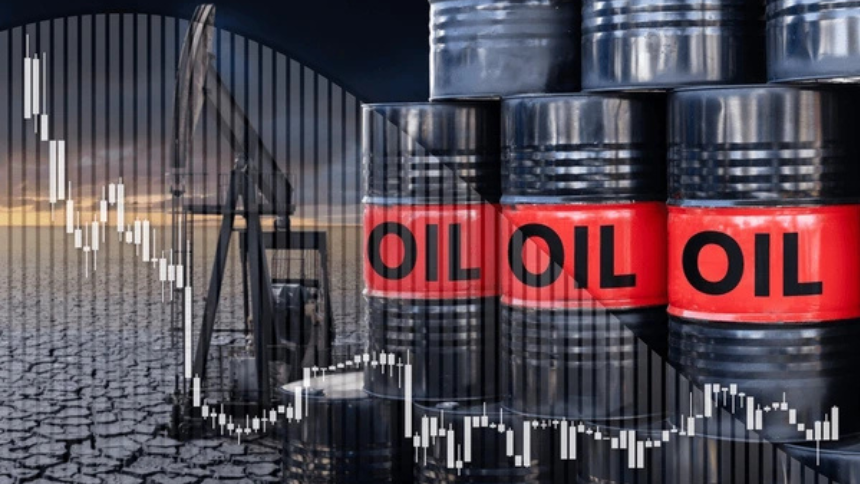
Oil prices began 2026 on a weak note after posting their worst annual loss since 2020. Brent and WTI fell nearly 20% in 2025, marking a third straight year of declines.
Oil prices settled lower on Friday, extending their biggest annual loss since 2020, as global supply concerns continued to outweigh escalating geopolitical tensions across major energy regions.
Brent crude futures fell 10 cents to close at $60.75 a barrel, while U.S. West Texas Intermediate dropped 10 cents to $57.32. The decline came on the first trading day of 2026, following a near 20% fall for both benchmarks in 2025.
It marked the third straight year of losses for Brent crude, the longest losing streak on record, underscoring a global oil market shaped more by oversupply than conflict.
Russia and Ukraine traded accusations of attacks on civilians on New Year’s Day, even as talks overseen by U.S. President Donald Trump continued. Ukraine has intensified strikes on Russian refineries, aiming to disrupt Moscow’s energy revenues that help fund its military campaign.


Despite the attacks, oil markets showed little reaction.
“Despite all these geopolitical concerns, the oil market seems unmoved,” said Phil Flynn, senior analyst at Price Futures Group. “There’s a sense the market will be well supplied no matter what happens.”
The Trump administration also increased pressure on Venezuela, imposing sanctions on four companies and oil tankers linked to its energy sector. Venezuelan President Nicolas Maduro said his country remained open to U.S. investment and renewed talks.
Meanwhile, unrest in Iran and deepening tensions in Yemen between OPEC producers Saudi Arabia and the United Arab Emirates added to global instability, including the temporary suspension of flights at Aden airport.
Yet analysts say these risks are being overshadowed by longer-term structural forces reshaping the energy market.
“Muted price movements reflect a tug of war between short-term risks and long-term fundamentals that still point to oversupply,” said Phillip Nova analyst Priyanka Sachdeva.
The Organization of the Petroleum Exporting Countries and allies, known as OPEC+, are due to meet on Sunday. Traders widely expect the group to maintain its pause on output increases into the first quarter of 2026.
“2026 will be important for assessing how OPEC+ balances supply,” said June Goh, analyst at Sparta Commodities. She added that China is expected to keep building crude stockpiles in the first half of the year, helping to limit further price declines.
The weak price trend also reflects a broader shift in global energy dynamics. High inventories, cautious demand growth, and increased focus on cleaner energy have softened oil’s role as a price setter in global markets.
Even major energy companies are facing pressure. Denmark’s Orsted said on Friday it would challenge the U.S. government’s suspension of a lease tied to its Revolution Wind project, highlighting rising legal and policy friction in energy investment.
As oil prices struggle to respond to war, sanctions, and unrest, the market appears to be sending a clearer signal: supply is abundant, demand growth is uncertain, and the era of conflict-driven price spikes may be fading.
Read also: Oil prices slip to five-month low as US-China tensions, supply fears frow

![U.S. LNG Export [Source: Reuters]](https://theenergytime.com/wp-content/uploads/2025/11/U.S.-LNG-Export-150x150.png)