
Nigeria earned N37.73 trillion ($91.5 billion) from crude oil exports in the first nine months of 2025, official data show, underscoring the country’s continued dependence on oil for foreign exchange.
The National Bureau of Statistics (NBS) published the Q3 2025 Foreign Trade in Goods Statistics, revealing stable crude oil export earnings despite global market volatility.
Quarterly figures indicate receipts of N12.96 trillion in Q1, N11.97 trillion in Q2, and N12.81 trillion in Q3. The cumulative N37.73 trillion demonstrates consistent performance, with no major fluctuations over the period.
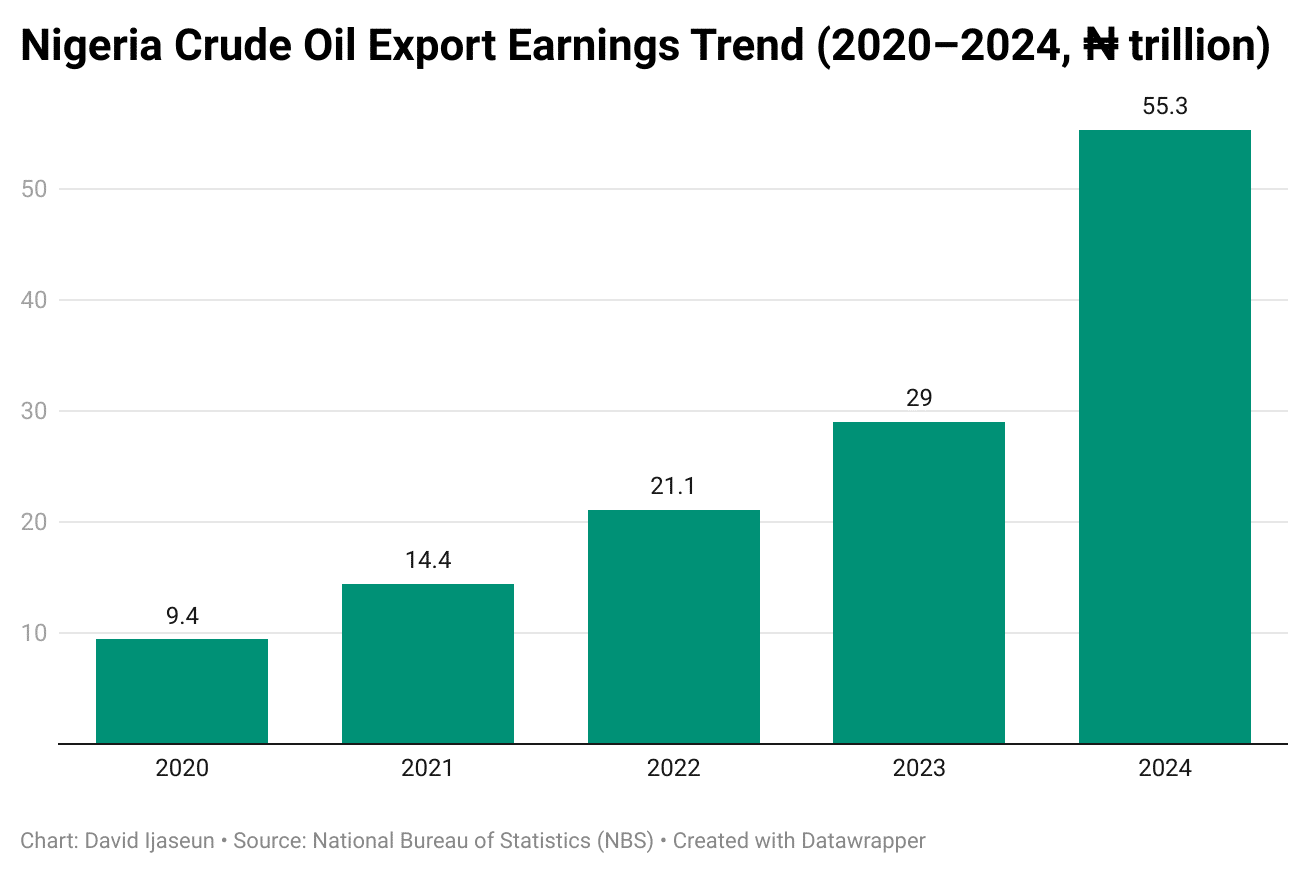
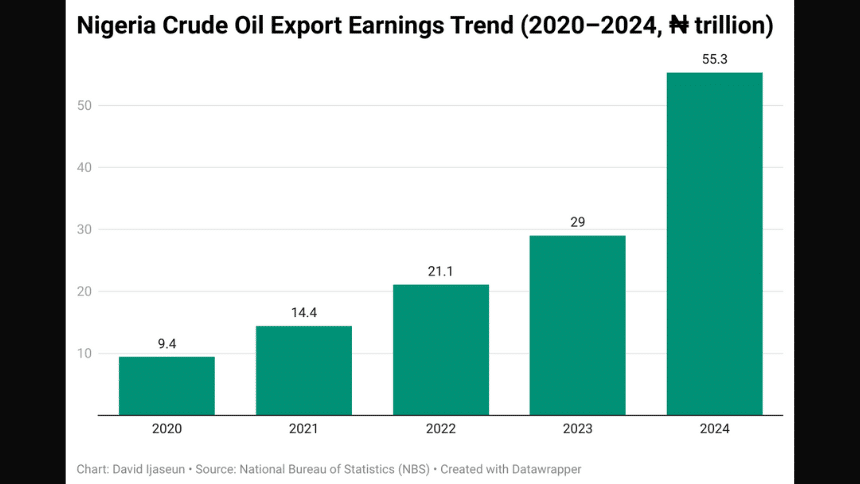
Over the past five years, Nigeria’s oil export earnings have grown steadily, rising from N9.44 trillion in 2020 to N14.41 trillion in 2021, N21.10 trillion in 2022, and N29 trillion in 2023. Revenues peaked at N55.29 trillion in 2024.
Despite higher revenues, profitability has weakened. Data show that oil and gas profits fell by N824.66 billion, to N1.08 trillion in 2024 from N1.90 trillion in 2023. Analysts attribute this to rising production costs, inefficiencies, and sectoral challenges.


Meanwhile, non-oil exports grew rapidly, hitting N9.2 trillion in the first nine months of 2025, up 48% from the same period in 2024. Non-oil exports include agricultural produce, manufactured goods, and solid minerals.
Despite the growth, non-oil goods accounted for only 12–14% of monthly exports in Q3, leaving oil and gas as the dominant foreign exchange source.
The figures highlight both progress and vulnerability. Oil earnings have stabilised Nigeria’s external trade, yet falling profitability signals structural inefficiencies. Policymakers are under pressure to boost non-oil sectors to diversify revenue and reduce reliance on crude oil.
The NBS data also suggest short-term resilience, with stable quarterly performance providing a buffer for government revenue planning. However, experts warn that long-term economic stability will require reforms, cost management, and stronger investment in non-oil industries.
Read also: Nigeria’s crude output rises slightly but misses OPEC quota for third month