Oil remains the backbone of the global economy in 2025, powering industries, transport, and households despite growing calls for cleaner energy.
The world’s ten largest oil companies, spanning Saudi Arabia, China, the US, the UK, and France, reported a combined revenue of over $2.9 trillion in the past year.
For investors, consumers, and governments, these numbers highlight both resilience and risk. While oil prices fluctuate and climate policies tighten, demand remains strong, keeping profits robust for the sector.
Saudi Aramco tops the list
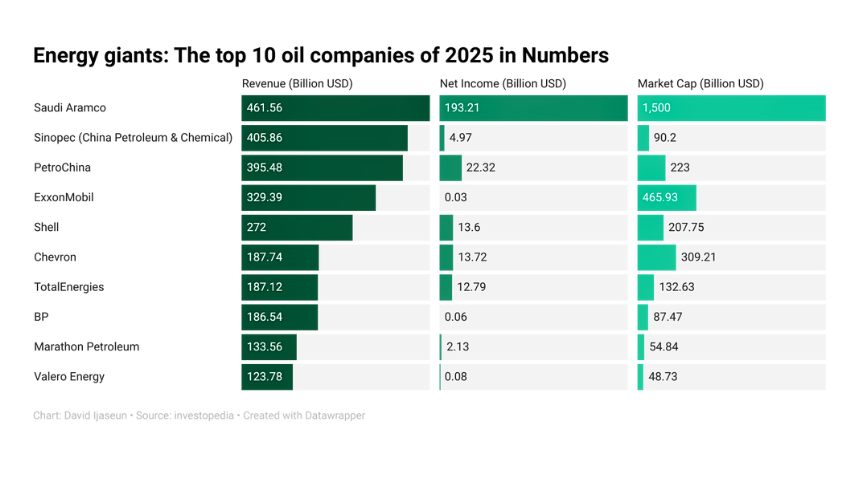
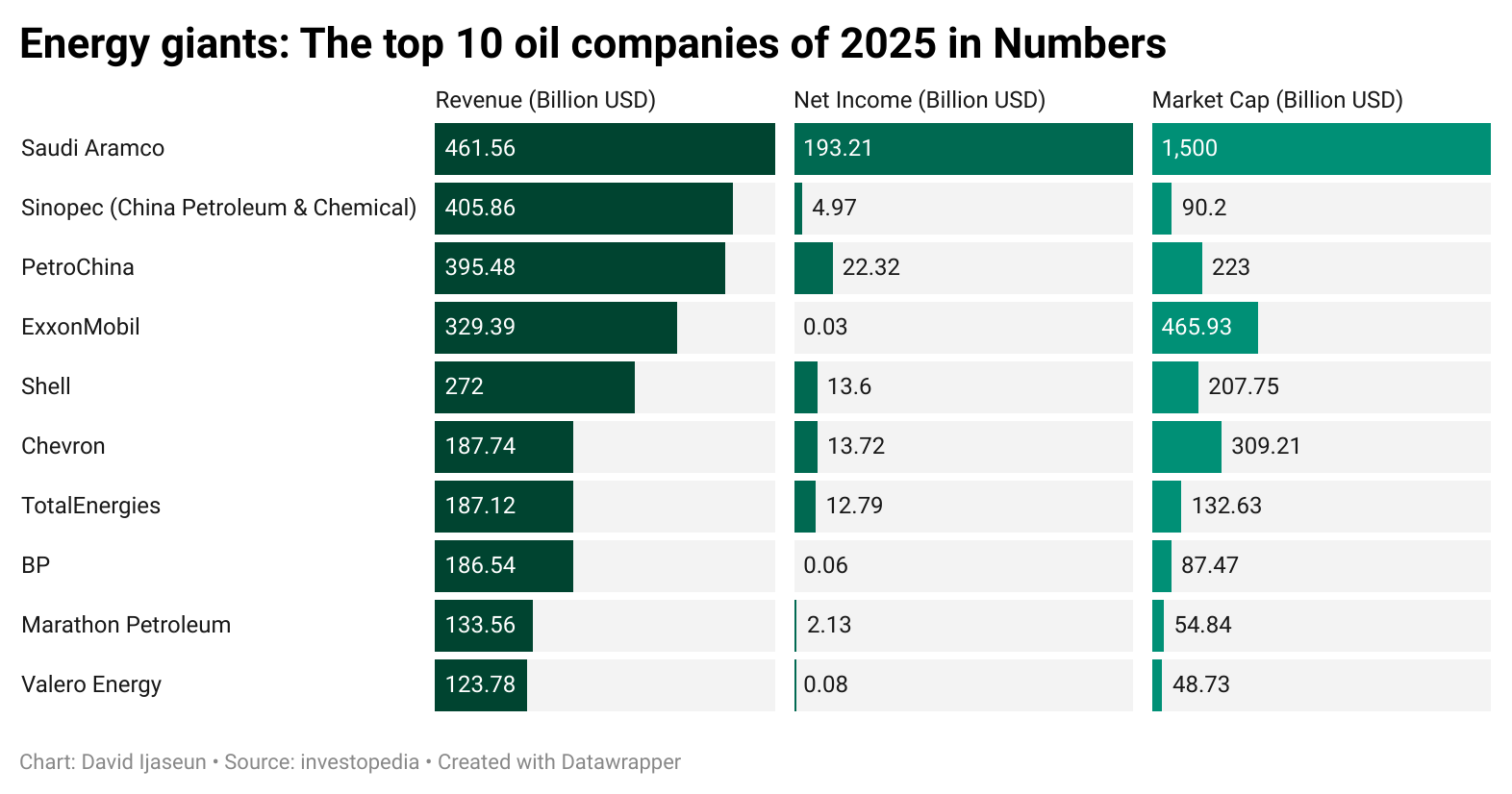
Saudi Aramco, the state-owned oil giant, led the global ranking with $461.5 billion in revenue and a net income of $193.2 billion. With a market cap of $1.5 trillion, it is also one of the most valuable companies worldwide.
“Aramco remains unmatched in scale,” said Aisha Al-Faraj, an energy policy researcher in Riyadh. “It dominates global oil supply, and its decisions ripple across every market.”
China holds second and third place
China Petroleum & Chemical Corporation (Sinopec) posted $405.9 billion in revenue, while PetroChina followed closely with $395.5 billion. PetroChina delivered $22.3 billion in net income, showing stronger profitability than Sinopec. Both companies supply over half of China’s oil and gas needs.


U.S. firms remain powerful
In the United States, ExxonMobil earned $329.4 billion, Chevron posted $187.7 billion, and Marathon Petroleum reached $133.6 billion. Valero Energy, the world’s largest independent refiner, recorded $123.8 billion in revenue.
Europe’s majors push transition
The European giants, Shell ($272 billion), BP ($186.5 billion), and TotalEnergies ($187.1 billion), all placed within the top 10. These companies have diversified into hydrogen, biofuels, and renewable energy, but fossil fuels remain their profit base.
The big picture
Collectively, these companies employ millions and fuel economies worldwide. Yet, their dominance raises questions about climate targets. Despite pressure to cut carbon emissions, oil still provides more than 80% of global energy demand, according to the International Energy Agency (IEA).
“The world faces a dual challenge,” said Anders. “We need energy security today, but also a clean future. The giants at the top will play a deciding role.”
Read more on Canada’s Oil Sands: Five things you need to know about world’s fourth-largest oil reserve