Nigeria’s energy sector in 2025 was marked by a decisive shift; local leadership stepping into the vacuum left by international oil companies (IOCs) divesting onshore assets. Nigerian CEOs managed complex infrastructure, advanced local refining, and drove the “Decade of Gas,” ensuring the sector remained a key pillar of the economy.
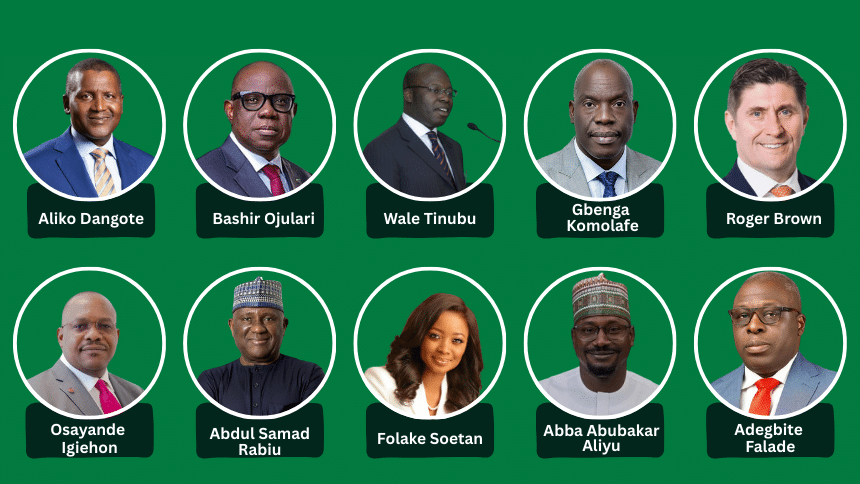
Here are the top 12 energy leaders who defined Nigeria’s oil, gas, and energy industry in 2025, along with their most notable achievements.
1. Aliko Dangote, CEO of Dangote Industries Limited
Aliko Dangote’s leadership in 2025 was defined by the full-scale commercialisation of the 650,000 bpd Dangote Refinery. By achieving maximum output for petrol (PMS), he single-handedly broke Nigeria’s 28-year reliance on imported fuel, saving the country an estimated $1.4 billion in foreign exchange in the first quarter alone.
His achievement created an “economic shield” for the nation, stabilising local fuel prices and reducing the logistical costs that previously drove inflation. By December, the refinery had outpaced international benchmarks, positioning Nigeria as a net exporter of refined products for the first time in decades.
Dangote achieved full-scale petrol production at the Dangote Refinery, saving Nigeria an estimated $1.4 billion in foreign exchange in the first quarter alone. By December, the refinery supplied nearly half of domestic petrol demand, breaking a 28-year reliance on imports.


2. Bashir Ojulari, Group Chief Executive Officer (GCEO) of the Nigerian National Petroleum Company Limited (NNPC Ltd.)
Bashir Ojulari oversaw the completion of the AKK Pipeline main line and achieved a production peak of 1.77 million barrels per day (bpd). His strategic focus on energy security and the transparency reforms initiated under the Petroleum Industry Act (PIA) transformed NNPCL into a more profitable, commercially driven entity that consistently outperformed previous revenue targets.
3. Wale Tinubu, Group Chief Executive of Oando PLC
Wale Tinubu’s 2025 was marked by the successful integration of Eni’s Agip assets, a landmark acquisition that cemented Oando’s position as Nigeria’s largest indigenous upstream producer. This move signaled a major shift in the industry, proving that local firms have the technical and financial capacity to manage complex, high-spec assets formerly held by International Oil Companies (IOCs).
The economic impact was immediate, as Oando reported a 164% profit rise by late 2025. Tinubu’s leadership at international forums like the G20 highlighted the maturity of African indigenous companies, successfully attracting fresh private capital and reinforcing global investor confidence in the Nigerian energy market.
4. Gbenga Komolafe, former CEO of Nigeria’s Upstream Petroleum Regulatory Commission (NUPRC)
Gbenga Komolafe led the 2025 Licensing Round, offering 50 exploration blocks to attract an estimated $10 billion in new capital. His reforms, including the reduction of signature bonuses to lower entry barriers, made the Nigerian upstream sector “irresistible” to serious global investors.
By October 2025, his leadership had driven the national rig count from a low of 8 to an impressive 69 rigs, representing a 760% surge in drilling activity. This geometric growth in exploration activity is expected to add up to 2 billion barrels to Nigeria’s reserves over the next decade.
5. Roger Brown, Chief Executive Officer (CEO) of Seplat Energy Plc
Roger Brown successfully closed the multi-billion dollar Mobil Producing Nigeria deal in 2025, a transaction that had been delayed for years. This achievement significantly boosted Seplat’s production capacity and solidified its standing as a top-tier regional energy powerhouse listed on both the Nigerian and London stock exchanges.
His leadership ensured that Seplat remained a leader in corporate governance and environmental standards. By bridging the gap between local talent and international capital, Brown ensured that the divestment of IOCs resulted in a stronger, more capable indigenous energy landscape.
6. Osayande Igiehon, MD/CEO Heirs Energies
In 2025, Osayande Igiehon led Heirs Energies to be named the “Independent Company of the Year” at SAIPEC. He achieved a remarkable feat by doubling hydrocarbon production at OML 17 to over 60,000 bpd, reactivating more than 60 wells in record time.
Igiehon’s focus on “brownfield engineering” turned underperforming assets into models of efficiency. His leadership proved that domestic firms could significantly enhance terminal delivery rates; taking them from 3% to 90%, thereby strengthening Nigeria’s overall energy security and domestic gas supply.
7. Abdul Samad Rabiu, the Founder & Chairman of the BUA Group
Abdul Samad Rabiu made significant strides in 2025 by accelerating the construction of the BUA Refinery & Petrochemicals plant in Akwa Ibom. His leadership provided much-needed competition in the domestic refining space, ensuring that the end of fuel imports led to a competitive market rather than a monopoly.
Beyond infrastructure, Rabiu’s commitment to “loyalty and excellence” saw his group disburse ₦30 billion to employees in late 2025, a move that highlighted the role of the energy sector in wealth distribution. His diversified business model across cement and food helped stabilize the broader economy during energy-related price fluctuations.
8. Folake Soetan, the Chief Executive Officer of Ikeja Electric Plc
In 2025, Folake Soetan was named one of the 100 Most Impactful People in Africa’s Energy and was inaugurated as a board member of the Nigerian Independent System Operator (NISO). Her leadership at Ikeja Electric prioritised “operational excellence,” including the commissioning of the Kwaru 15MVA Injection Substation.
Her achievements in 2025 extended to workplace safety and technological innovation, where she expanded smart metering to curb energy theft. By focusing on customer-centric solutions and grid modernization, she set a high standard for female leadership in a traditionally male-dominated utility sector.
9. Abba Abubakar Aliyu, Managing Director, Rural Electrification Agency (REA), Nigeria
Abba Abubakar Aliyu led a “Renewable Revolution” in 2025 by deploying over 200 mini-grids that provided electricity to 17.5 million Nigerians. He also secured the largest budget in REA history (₦100bn) for the National Public Sector Solarisation Initiative (NPSSI).
His leadership catalysed a surge in local manufacturing, increasing Nigeria’s solar panel capacity from 120MW to over 600MW. By securing $435 million in investments for new manufacturing plants, Aliyu ensured that Nigeria’s energy transition was fueled by locally made components, creating thousands of green jobs.
10. Adegbite Falade, CEO of Aradel Holdings Plc
In 2025, Adegbite Falade strengthened Nigeria’s energy sector through operational excellence and strategic growth. Under his leadership, gas production surged 41%, refined product output rose 40%, and crude oil production increased by 25%, boosting the company’s revenue to ₦538.8 billion. Key acquisitions, including additional stakes in ND Western and Renaissance Africa Energy, expanded Aradel’s upstream and midstream footprint, while sustainability initiatives, such as reducing gas flaring to <0.05%, reinforced the company’s environmental responsibility.
By driving domestic gas monetisation, enhancing refinery capacity, and improving operational efficiency, he contributed significantly to energy security, economic stability, and investor confidence in Nigeria’s oil and gas sector. His leadership positioned Aradel as a model for integrated energy growth, sustainable practices, and value creation across the country.
Read also: Ten numbers that defined Nigeria’s energy shift in 2025