
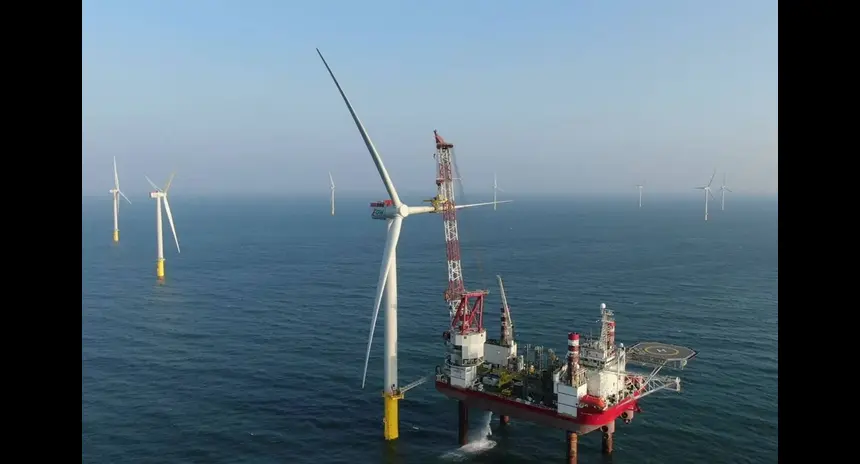
The US offshore wind sector has suffered another setback after Danish developer Orsted’s 704-MW Revolution Wind project was ordered to halt work on 22 August, triggering a sharp 17% drop in the company’s share price three days later.
The wind farm, located around 15 miles off Rhode Island’s coast, was already 80% complete, and an injunction was initially considered unlikely given the progress achieved.
The Bureau of Ocean Energy Management (BOEM) issued the order “to allow time to address concerns” identified in a review led by the US Department of the Interior. The review stems from former President Donald Trump’s executive order of 20 January to freeze new offshore wind projects and assess the legal grounds for cancelling or amending existing leases.
BOEM said the concerns centre on national security and the risk of interfering with other maritime activities in the region.
Reacting to the decision, Orsted stated on 23 August that it was “evaluating all options to resolve the matter quickly,” which could include discussions with permitting authorities or potential legal action. The company said it still intends to complete the project in the second half of 2026, noting that 45 of the planned 65 turbines have already been installed.


Revolution Wind holds all required permits and has secured a 20-year power purchase agreement with Rhode Island and Connecticut. The scheme is jointly owned by Orsted and Skyborn Renewables, part of Global Infrastructure Partners, which each hold a 50% stake.
Investor backlash
The stop-work order rattled investors, pushing Orsted’s shares down 17% at the 25 August open. The decline followed a record low earlier in the month after the company launched a DKr60 billion rights issue.
The capital raise was prompted by what Orsted described as an “extraordinary and unprecedented” challenge in the US market: the April suspension of Equinor’s 810-MW Empire Wind 1 project off New York.
Although that order was lifted after about a month, the episode raised doubts over the stability of the US offshore wind industry, complicating Orsted’s efforts to secure financing for its 924-MW Sunrise Wind development.
“This is another blow for Orsted and the broader US offshore wind sector. The key issue now is whether an agreement can be reached to resume work on the project,” analysts at Jefferies said in a 24 August note. They warned that the halt would increase the risk of further financial impairments and create a more difficult backdrop for Orsted’s forthcoming rights issue.
Orsted stressed that it was investing heavily in US energy infrastructure, including grid upgrades, ports, shipbuilding and supply chain development across more than 40 states. Revolution Wind is already employing hundreds of unionised local workers, the company added.
Even so, analysts at Jefferies said Orsted’s response offered limited reassurance. In the best-case scenario, they said, the order would be lifted within a month and construction schedules would remain largely intact, though they still expected some additional impairments.
Credit ratings under pressure
Orsted’s financial woes deepened earlier this month when S&P Global Ratings downgraded the company from BBB to BBB- with a stable outlook, citing hurdles in its asset disposal strategy.
CreditSights analysts wrote in a 25 August note that while they had disagreed with S&P’s downgrade at the time, the latest halt appeared to vindicate the move. They added that it was now reasonable to expect Moody’s and Fitch to follow suit with similar rating cuts.
In its 14 August report, S&P Global Ratings had noted it did not anticipate a stop-work order against any Orsted project. “If this were to occur, it could have a material impact on Orsted’s business model and credit ratios,” the agency warned.