



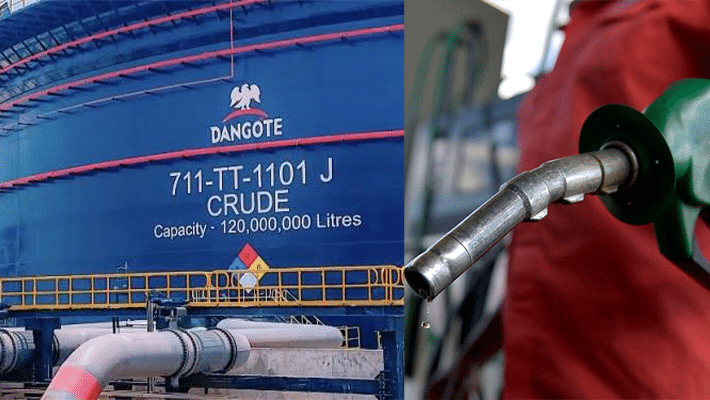
Nigeria’s downstream petroleum market is facing growing tension as fuel marketers raise alarm over what they describe as disruptive and unsustainable price reductions implemented by the Dangote Refinery.
This practice, they said, is inflicting immediate financial losses, destabilising market operations, and pushing many operators to the brink of collapse.
In separate interviews, the Petroleum Products Retail Outlets Owners Association of Nigeria (PETROAN) and the Independent Petroleum Marketers Association of Nigeria (IPMAN) detailed how rapidly changing pump prices, sometimes adjusted within days or even hours, have trapped marketers with high-cost inventory they can no longer sell competitively.
Sudden price drops creating instant losses
Marketers buy Premium Motor Spirit (PMS) from Dangote at prices ranging from ₦850 to ₦880 per litre, only for the refinery to slash rates to ₦820–₦830 shortly afterwards. For retailers who typically operate on margins below ₦20 per litre, a sudden ₦40–₦50 reduction is catastrophic.
“This is the question we’re asking: if we bought at ₦858 and he reduces the price before we sell what we purchased, who pays for that difference?” PETROAN President, Dr. Billy Gillis-Harry, said.


He described the pattern as “low price modulation” that grants Dangote a competitive edge but risks driving smaller operators out of the market.
For independent marketers, the challenge is even more severe. IPMAN National Vice President, Zarma Mustapha, said many of their members operate in hinterland areas where haulage from coastal depots takes 4 to 8 days. By the time the product reaches their stations, Dangote may have already slashed the price again, wiping out their capital in one swoop.
“You bought at ₦878 last week. The next morning, Dangote announced a reduction of about ₦50. With a profit margin not up to ₦20, how do you survive?” Mustapha said. “A lot of marketers are going to be out of business. Their capital will be completely wiped out.”
Market distortion and regulatory concerns
Both associations warned that the refinery’s pricing strategy, though welcomed by consumers in the short term, poses a long-term threat to competition and market sustainability.
According to PETROAN, Dangote’s pricing behaviour risks “killing every other business,” a development that could result in market monopoly and future price shocks for Nigerians.
IPMAN echoes this concern, saying the abrupt reductions “do not make business sense” and undermine the principles of a competitive market economy.
They are urging the Federal Competition and Consumer Protection Commission (FCCPC) and other regulators to intervene by introducing a structured pricing mechanism that prevents extreme, sudden price drops without adequate notice or phased adjustments.
Downstream stability at risk
Industry leaders say the country may be heading toward a crisis where temporary consumer gains mask a looming collapse of the fuel distribution ecosystem.
“You cannot reduce price by ₦15, ₦20, or ₦50 overnight when marketers still hold stock purchased at higher rates,” Mustapha said.
Gillis-Harry added that while Dangote has the right to adopt any business model, it must not jeopardise the survival of the wider market: “We want his refinery to be successful. But while he succeeds, you don’t want to kill every other business. That is the problem.”
Calls for government action
Both PETROAN and IPMAN insist that the government must urgently establish rules that protect market participants from destabilising pricing practices. They recommend a regulator-led price modulation system that:
- Prevents sudden, large price cuts
- Phases adjustments over reasonable intervals
- Ensures equal access to refinery products
- Protects the investments of smaller players
Marketers warned that failure to act now risks collapsing a sector critical to national mobility, economic activity, and energy security.

![China at COP30 in Brazil [Source Reuters]](https://theenergytime.com/wp-content/uploads/2025/11/China-at-COP30-in-Brazil-Source-Reuters-150x150.png)