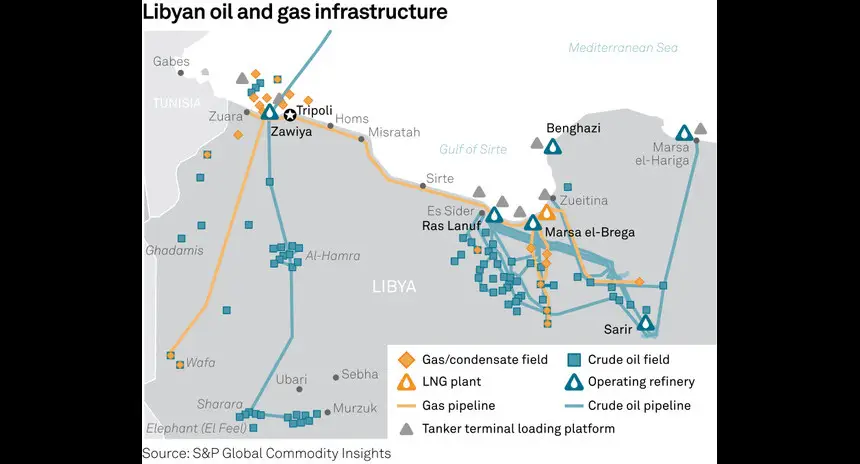
An oil spill along a pipeline south of Libya’s Zawiya refinery and export terminal remained unresolved as of 27 May, disrupting crude oil deliveries from the Hamada fields, according to industry sources.
In a statement released over the weekend, the Libyan National Oil Corporation (NOC) confirmed that emergency response and maintenance teams had been deployed to contain the leak. The company also shared images showing oil leaking into the desert.
Arabian Gulf Oil Company (AGOCO), a major subsidiary of NOC, acted swiftly after discovering the leak. “Production from the Hamada fields via this line was immediately suspended, and the valve in the Rayana area was closed,” the statement read.
NOC added that the exact cause of the spill had yet to be determined. The company pledged to recover the spilled crude and mitigate any environmental damage caused by the incident.
Sources confirmed on 27 May that the leak had not yet been brought under control.


AGOCO, which manages the significant Sarir and Mesla oilfields, had reached a multi-year production peak of 304,000 barrels per day in March, according to NOC.
Efforts to reach NOC for additional comments were unsuccessful at the time of writing.
Although the precise output of the Hamada fields is not publicly available, data from S&P Global Commodity Insights estimated it to be under 1,000 barrels per day. In September 2024, AGOCO announced it had boosted production at its V29-NC8A well to 550 barrels per day.
SLB was recently awarded a contract to develop the North Hamada 47 field, targeting up to 10,000 barrels per day. Meanwhile, the NC-7 Hamada gas development—long embroiled in political controversy—reportedly has the capacity to produce 200 million cubic feet of gas per day, alongside substantial oil volumes.
Located in Libya’s Ghadames Basin, the Hamada field sits around 135 kilometres northwest of the al-Hamra oilfields, which are also operated by AGOCO and yield approximately 6,000 barrels per day, according to S&P Global data.
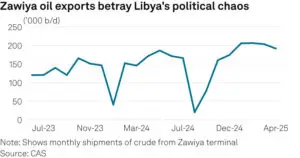
Zawiya serves as a crucial oil infrastructure hub in western Libya, under the control of the UN-recognised Government of National Unity (GNU). Since the fall of Moammar Qadhafi in 2011 and the subsequent civil conflict, Libya has been divided between rival eastern and western administrations.
The Zawiya refinery is the country’s main crude processing facility, with a designed capacity of around 120,000 barrels per day. However, actual throughput is believed to be much lower. The facility has frequently been a target for armed groups, political factions, and protesters during episodes of instability.
The refinery and associated export terminal are supplied by Libya’s largest oilfields—Sharara (300,000 bpd) and El-Feel (90,000 bpd)—which are operated by international oil companies. As of 27 May, the spill had not impacted flows from these fields or refinery operations.
The oil spill occurred amid escalating violence in Tripoli, following the reported assassination of a prominent militia leader, triggering the most intense fighting in years. In response to widespread public unrest, three ministers from the GNU resigned, dealing a significant blow to Prime Minister Abdul Hamid al-Dbeiba’s leadership, analysts noted.
This latest turmoil comes shortly after Libya reached its highest oil production level in 12 years—1.2 million barrels per day—according to the Platts OPEC Survey by S&P Global Commodity Insights.
Libya remains a key supplier of light sweet crude oil and natural gas to Europe, especially as the continent seeks alternatives to Russian energy amid the ongoing Ukraine conflict.
In its most recent daily report on 23 May, NOC stated that Libya’s output of crude and condensates had reached 1.38 million barrels per day.