
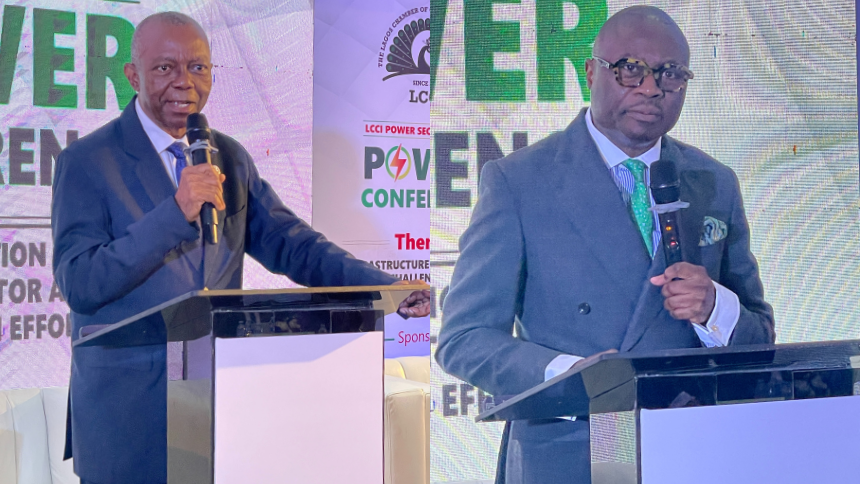
Lagos State and private-sector leaders have called for urgent reforms to modernise Nigeria’s ageing electricity infrastructure, as decentralisation accelerates state-level participation in the power market.
They made this known at the Lagos Chamber of Commerce and Industry (LCCI) Power Sector Conference, themed “Infrastructure Optimisation and Challenges in the Power Sector Amidst the Current Decentralization Report”, today.
Speaking at the Conference, Biodun Ogunleye, Lagos Commissioner for Energy and Mineral Resources said the state had moved ahead of national reforms by establishing the Lagos Electricity Market framework, the Lagos Electricity Law and the Lagos State Electricity Regulatory Commission (LASERC).
Represented by Ogunade Hamed, Chief Technical Officer, the commissioner stated that Lagos is now implementing measures that shift power sector development from policy discussions to practical delivery.
“Our distribution and transmission networks require significant investment and smarter management. We cannot deliver reliability on infrastructure designed for a smaller population and a different economy,” he said.


He disclosed that Lagos is strengthening its embedded-generation framework for industrial clusters, modernising street lighting with 42,000 solar retrofits, and expanding regulatory support for mini-grids and hybrid systems as part of efforts to boost reliability.
But he warned that infrastructure gaps, commercial sustainability concerns and weak value-chain coordination remain substantial hurdles for states building decentralised electricity markets.
The Commissioner said progress will depend on collaboration among state regulators, the private sector and federal agencies. “The decentralised era is here, and Lagos is ready,” he added.
Gabriel Idahosa, LCCI President and Chairman of Council, said Nigeria’s shift to state-driven electricity markets has opened the door for innovation and competition but has simultaneously exposed entrenched weaknesses across the system.
He cited generation shortfalls, limited gas supply, over-stretched transmission infrastructure, poor distribution performance and inadequate investment in off-grid solutions as persistent constraints.
“Nigeria cannot industrialise without reliable electricity. The private sector is ready to invest, provided the regulatory environment is predictable, transparent and efficiently coordinated,” Idahosa said.
He said issues such as cost-reflective tariffs, investor confidence, renewable-energy integration and data transparency must be addressed to ensure states do not replicate the inefficiencies of the centralised market.
Olufemi Bakare, Chairman of the LCCI Power Group, said ongoing reforms and decentralisation efforts must be accompanied by targeted investments to optimise infrastructure and strengthen power delivery across the value chain.
“The challenges are multifaceted, ranging from infrastructure deficits and regulatory hurdles to transmission and distribution issues. We must address these obstacles collectively,” Bakare said.
The conference brought together policymakers, financiers, operators and technology firms to examine how Nigeria can align decentralisation with infrastructure revival and increased private-sector investment.