Electricity access has been a major challenge for many African countries. With more than 600 million people still living without power, governments across the continent have made power sector investment and expansion a top priority to drive socioeconomic growth and industrialisation.
In pursuit of the United Nations’ Sustainable Development Goal 7, which targets universal access to affordable, reliable, and modern energy, many African nations have made notable progress in recent years, with several now standing out as continental leaders in electrification.
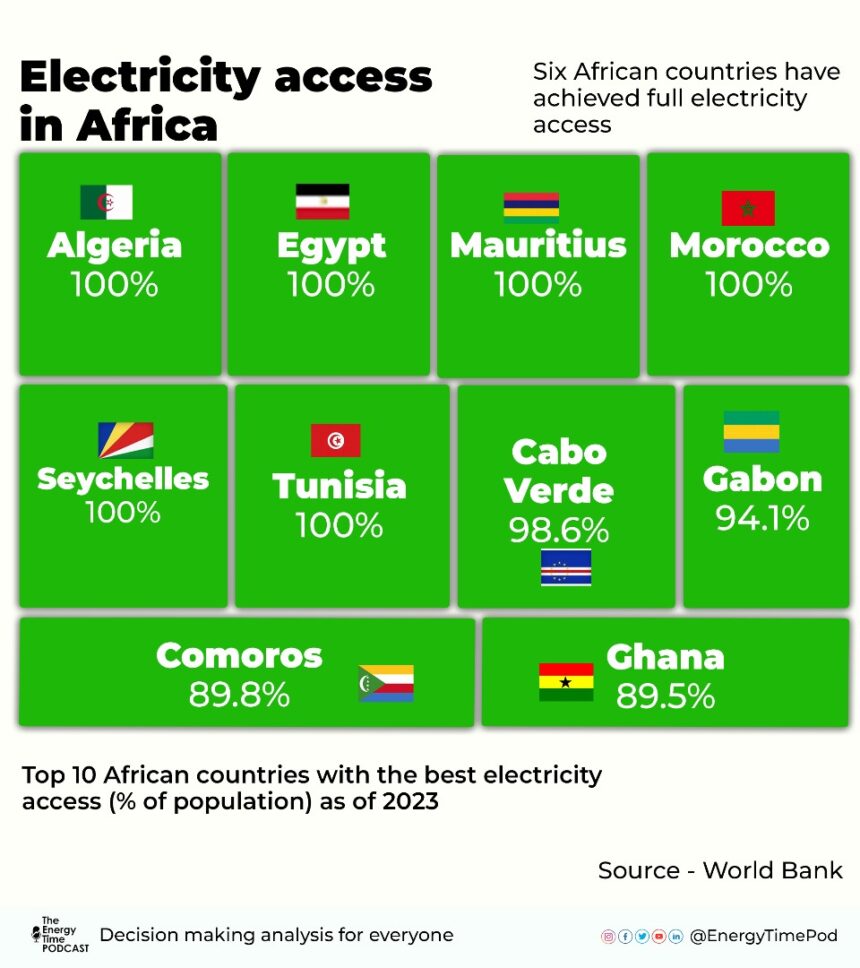
Six African countries, Algeria, Egypt, Mauritius, Morocco, Seychelles, and Tunisia, have achieved universal electricity access, making them the continent’s leaders in energy connectivity, according to the World Bank’s latest data on electrification across Africa in 2023.
The data, which was last updated in October 2025, showed that these six countries recorded 100 percent access for their populations, highlighting the progress made in North Africa and small island states toward achieving Sustainable Development Goal 7 (SDG 7), which seeks to ensure affordable, reliable, sustainable, and modern energy for all.
Cabo Verde, another island nation, followed closely with 98.6 percent of its population connected to the grid, while Gabon recorded 94.1 percent, making them the only two sub-Saharan African countries among the top ten with near-universal electricity coverage.


Comoros and Ghana complete the list of the top 10 African countries with the best electricity access, recording 89.8 percent and 89.5 percent, respectively.
The rankings reflect significant disparities in power access across the continent. While North and island nations have achieved near-complete coverage, many sub-Saharan countries continue to struggle with electrification, particularly in rural areas.
Experts said the strong performance of North African countries can be attributed to sustained investment in power infrastructure, integration of renewable energy, and robust government policies aimed at universal access.
Energy analysts noted that maintaining high access rates will require continuous infrastructure upgrades, especially as populations and energy demand rise. They also stressed that countries with lower access levels must accelerate grid expansion and embrace off-grid and renewable solutions to bridge the energy gap.