


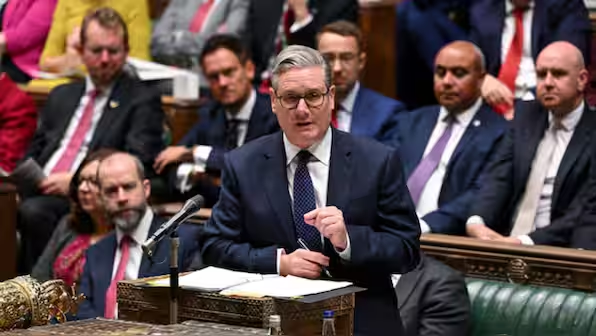
The UK government is preparing to set out major reforms of the asylum system, with Home Secretary Shabana Mahmood expected to present the plans to Parliament on Monday.
The proposals focus on reducing the number of new asylum claims and increasing the removal of people who do not have the right to remain in the country. The reforms draw on policies used in Denmark and other European states.
Government Plans Modelled on Denmark’s Approach
Government sources, according to BBC , reveal that the UK intends to reshape its asylum framework by adopting measures similar to those introduced by Denmark’s centre-left government in recent years. Those reforms include:
Temporary residence permits for refugees, regular reassessment of protection claims, and longer and more complex routes to citizenship.


Denmark introduced its changes in 2016. According to the BBC, the country’s asylum applications later fell to a 40-year low. Danish policy also allows temporary permits of about two years, after which individuals must reapply. Even when extensions are granted, the process toward long-term settlement or citizenship remains limited.
In 2020, Denmark moved to return about 200 refugees to Syria on the basis that certain areas around Damascus were assessed as safe. Reports inform that the UK government has sent senior officials to Denmark to examine elements of the system that could be adapted for use in Britain.
UK Government Cites Rising Pressures and Removal Figures
Ministers argue that the current UK system encourages what they describe as “asylum shopping”. Government sources say people are drawn to the UK by what they claim is “excessive generosity and the ease of remaining”. The Home Office says next week’s announcement represents the largest set of policy changes on irregular migration “in modern times”.
Mahmood is expected to tell MPs the government’s aim is “less in, more out”. New Home Office figures indicate that nearly 50,000 people classed as illegal migrants have been removed or deported since Labour entered government in July 2024. According to the government, this is a 23% increase compared with the previous 16-month period.
Debate Over Legal Constraints and International Obligations
The reforms will take place within the framework of the European Convention on Human Rights (ECHR). Denmark has maintained its immigration rules while remaining a signatory to the Convention, and the UK government has highlighted this as evidence that significant changes can be made without withdrawal.
Labour has committed to reassessing how international law, including the ECHR, is interpreted by domestic courts. The intention is to limit the ability of unsuccessful asylum seekers to challenge deportation decisions based on conditions they may face in receiving states, such as prison or healthcare standards.
Reform UK and the Conservative Party argue that leaving the ECHR outright would be more effective. Conservatives also maintain that the government cannot stop small boat crossings without reinstating a deterrence scheme similar to the former Rwanda policy.
Parliamentary Statement Expected Monday
Mahmood will present the full package of reforms to MPs on Monday. The announcement will outline how the government intends to implement the new approach and what changes will be introduced to asylum processing, removal powers, and long-term residence rules.
![Water Bankruptcy in Iran: Iranian women pray for rain in Tehran, November 14. In the past, people would go out to the desert to pray for rain,” said Mehdi Chamran, head of Tehran’s City Council [Source Reuters]](https://theenergytime.com/wp-content/uploads/2025/11/Iranian-women-pray-for-rain-in-Tehran-November-14.-In-the-past-people-would-go-out-to-the-desert-to-pray-for-rain-said-Mehdi-Chamran-head-of-Tehrans-City-Council-Source-Reuters-150x150.png)