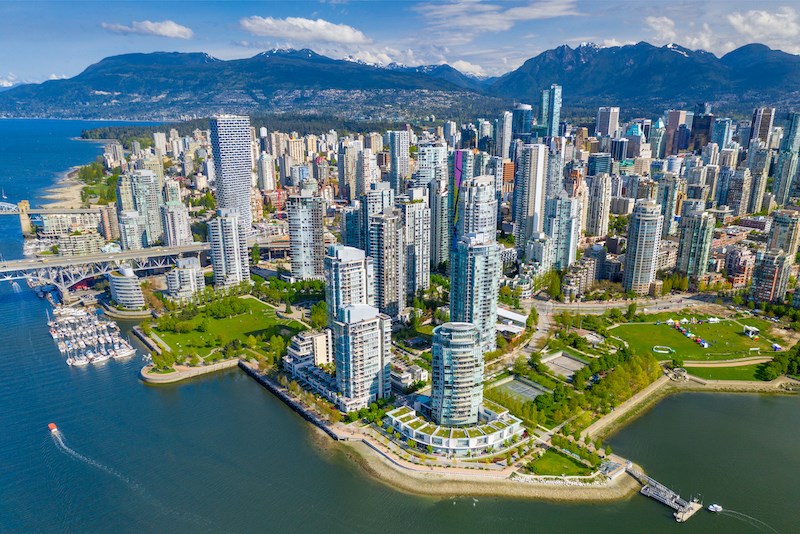
Vancouver has been ranked the most liveable city in Canada for 2025, according to a curated analysis combining the Economist Intelligence Unit (EIU)’s Global Liveability Index 2025 and additional national data.
Other Canadian cities in the top three are Calgary and Toronto, which also ranked within the global top 20.
According to Immigration News Canada (INC), this national ranking bridges the gap left by the EIU’s global index, which only evaluates four Canadian cities—Vancouver, Toronto, Calgary, and Montreal—without providing a definitive Canadian top 10 list. The rankings below combine international scores and local assessments from sources including The Globe and Mail.
Methodology and Scoring Criteria
The EIU ranks global cities on a 1–100 scale across five weighted categories: Stability (25%), Healthcare (20%), Culture and Environment (25%), Education (10%), and Infrastructure (20%). The global average score in 2025 is 76.1. Canadian cities typically score above 80.


Vancouver scored 95.8, placing it 10th globally. Calgary followed with 94.7, while Toronto’s estimated score is around 90, placing it 16th. Montreal scored approximately 80 and is ranked around 19th globally. The remaining cities on the Canadian list are ranked using recent national reports and historical trends.
Canada’s Top 10 Most Liveable Cities in 2025
Here is the full list of Canada’s most liveable cities in 2025:
Vancouver, BC – 95.8
Calgary, AB – 94.7
Toronto, ON – ~90
North Vancouver, BC – ~85
Victoria, BC – ~84
West Vancouver, BC – ~83
Ottawa, ON – ~82
Montreal, QC – ~80
Oakville, ON – ~80
Saskatoon, SK – ~79
These cities were selected for their balanced performance in both global and national assessments. While not ranked globally, cities such as North Vancouver and Saskatoon are recognised for strong local liveability indicators, including community infrastructure, affordability, and access to education.
Key Strengths and Limitations of Top-Ranked Cities
Vancouver remains Canada’s most liveable city. Its score of 95.8% shows top marks in culture, environment, and education. However, its healthcare system faced strain in 2025, and housing affordability remains an ongoing challenge.
Once ranked 5th globally, Calgary dropped to 18th due to similar healthcare concerns. Still, it maintains strong affordability, infrastructure, and access to green spaces.
Toronto consistently ranks in the top three nationally and 16th globally. Its strengths are cultural diversity, education, and economic opportunities. However, high living costs and traffic congestion have negatively affected its infrastructure score.
Montreal, estimated to be ranked around 19th globally, stands out for affordability and cultural life but faces challenges in infrastructure and healthcare.
Cities not included in the global EIU list—like Victoria, Oakville, and Saskatoon—were selected based on their performance in The Globe and Mail’s national rankings and qualitative factors such as local healthcare access, climate, and community engagement.
Global Context and Comparative Rankings
Vancouver is the only Canadian city in the EIU’s global top 10. For comparison:
Copenhagen, Denmark, leads globally with a score of 98.0.
Vienna, Austria, and Zurich, Switzerland, followed with scores of nearly 97.
Vancouver ranks 10th with 95.8.
EIU data indicates that while Canada performs well in cultural and educational metrics, healthcare system issues have impacted several cities’ scores.
National Trends Affecting Liveability
Canada’s liveability outlook in 2025 is shaped by several national trends:
- Healthcare strain is a major concern, particularly in Vancouver, Toronto, Calgary, and Montreal.
- Housing affordability remains a dividing factor, with lower costs in cities like Saskatoon and Calgary compared to high-cost areas like Vancouver and West Vancouver.
- Climate differences play a role, with milder conditions in Victoria contrasting with harsh winters in Saskatoon and Montreal.
- Infrastructure investment needs are noted in cities like Toronto and Montreal.
Despite these challenges, Canadian cities perform above global averages in multiple categories, particularly in environment and education.
5 Timely Ways Trump’s Travel Ban Disrupts International Plans