
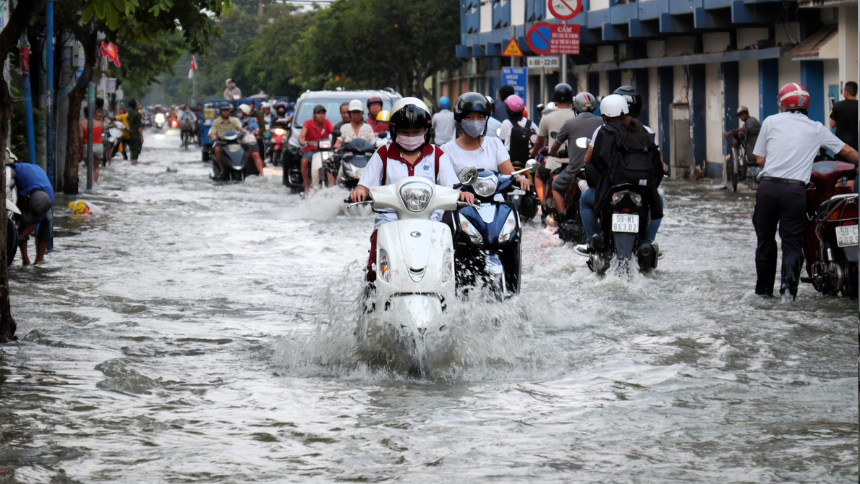
Millions across Asia are battling deadly floods after Typhoon Kajiki slammed into Vietnam, and heavy monsoon rains forced Pakistan to evacuate 150,000 people, raising fears of more loss of life, destroyed crops, and strained ties between nuclear-armed rivals India and Pakistan.
Kajiki has killed at least three people in Vietnam and injured ten, officials confirmed. Nearly 7,000 homes were damaged, and 28,800 hectares of rice fields, a vital food source, were submerged. Authorities said 18,000 trees were felled, while 331 electricity poles collapsed, cutting power in several northern provinces,, including Thanh Hoa, Nghe An, and Ha Tinh.
“People are terrified. We saw cars fully underwater, and families rushing to rooftops for safety,” said Nguyen Van Duc, a Hanoi resident.
In the capital, Hanoi’s streets turned into rivers, with water submerging vehicles up to their roofs. State TV showed West Lake spilling over its banks, while several villages in Bac Ninh province were cut off. The floods come just days before Vietnam’s 80th National Day parade, its biggest in decades.
Kajiki made landfall on Monday before weakening into a tropical depression and moving into Laos. Yet Vietnam’s weather agency warned that some areas may still see up to 150mm (6 inches) of rain in just six hours, risking flash floods and landslides.


Before hitting Vietnam, Kajiki skirted China’s Hainan Island, forcing Sanya City to shut businesses and suspend public transport.
Meanwhile, in Pakistan, 150,000 people have been evacuated from Punjab province, the country’s agricultural heartland, as India warned it may release excess water from a dam. Officials said 35,000 people left voluntarily after repeated early warnings since August 14.
“This is about saving lives. We cannot risk waiting for the rivers to rise further,” said Mazhar Hussain, a senior disaster management official.
India had warned Islamabad that heavy rain in its territory was filling reservoirs, prompting controlled releases into Pakistan’s rivers Ravi, Sutlej, and Chenab. The move, while routine, comes amid tense relations between the two countries following deadly clashes in May.
Pakistani officials fear that hundreds of villages and 1,450 livestock could be displaced, with relief camps already providing food, medicine, and shelter. “Eastern rivers are seeing more rain than ever before. This is climate change in real time,” said Kazim Raza Pirzada, irrigation minister of Punjab.
The floods threaten Pakistan’s food security. Punjab produces most of the country’s staple crops and is home to half of its 240 million people. Already, monsoon floods this year have killed 799 people nationwide, with the northwest hardest hit by glacial melt and landslides.
The situation risks straining fragile diplomacy. India suspended a decades-old water treaty with Pakistan earlier this year after blaming Islamabad for an attack in Kashmir. Officials in New Delhi said the latest warning was shared on “humanitarian grounds.”
As both Vietnam and Pakistan brace for more rain, the storms highlight how climate change is intensifying Asia’s monsoon systems, displacing millions, destroying farmland, and inflaming cross-border disputes.
Read also: Texas floods leave 120 dead, thousands of vehicles lost in $22bn disaster