
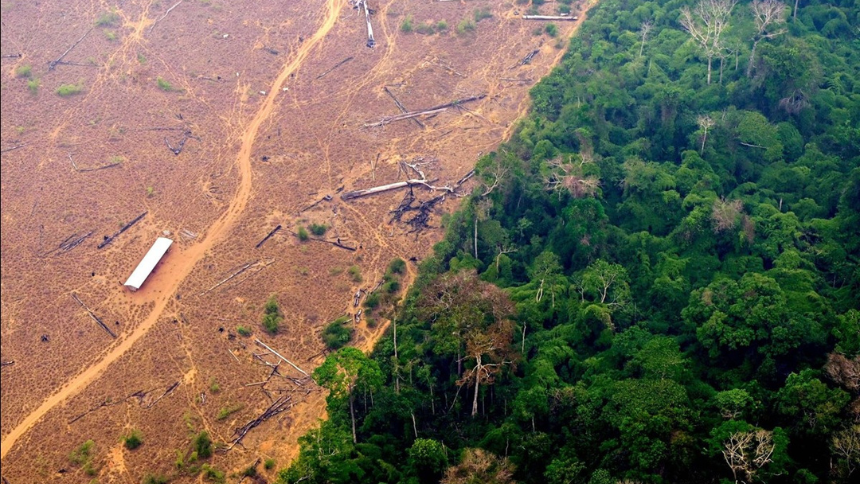
The world lost 8.1 million hectares of forest in 2024, according to the latest Forest Declaration Assessment. That amount is roughly the size of England.
That loss pushes the planet 63% behind the goal set by more than 140 nations in the 2021 Glasgow Declaration on Forests and Land Use.
The report names fires and agriculture as the two main culprits. Fires alone destroyed 6.73 million hectares, especially in the Amazon. That released nearly 800 million metric tons of CO₂.
“Major fire years used to be outliers, but now they’re the norm. And these fires are largely human-made,” said Erin Matson, the report’s lead author. “They’re linked to land clearing, drought, and weak law enforcement.”
Agriculture accounted for 86% of permanent deforestation over the past decade. Mining for gold and coal is also a rising threat, the report adds.


“Demand for soy, beef, timber, coal and metals keeps rising,” Matson said, “yet we don’t need to destroy forests to meet that demand.” She said over $400 billion in agricultural subsidies help drive deforestation.
Meanwhile, international public finance for forest protection averages only $5.9 billion a year. To reach the 2030 goals, the report estimates $117–299 billion annually is needed.
With COP30 set in Brazil in November, attention turns to Brazil’s proposal; the Tropical Forest Forever Facility (TFFF). It seeks to raise $125 billion from governments and private investors.
If launched, TFFF could disburse $3.4 billion a year, with 20% directed to indigenous and local communities.
“Looking at the global picture of deforestation, it is dark, but we may be in the darkness before the dawn,” Matson said.
Read also: COP30 in Brazil: Exorbitant hotel costs push delegations to withdraw
![Russia moves to end fuel shortage [Reuters]](https://theenergytime.com/wp-content/uploads/2025/10/Russia-moves-to-end-fuel-shortage-150x150.png)