![Water Bankruptcy in Iran: Iranian women pray for rain in Tehran, November 14. In the past, people would go out to the desert to pray for rain,” said Mehdi Chamran, head of Tehran’s City Council [Source Reuters]](https://theenergytime.com/wp-content/uploads/2025/11/Iranian-women-pray-for-rain-in-Tehran-November-14.-In-the-past-people-would-go-out-to-the-desert-to-pray-for-rain-said-Mehdi-Chamran-head-of-Tehrans-City-Council-Source-Reuters.png)
In Tehran, Iran’s sprawling capital, a new, message competes with the usual political slogans, “There is a water shortage!”
Indeed, this dire warning reflects a reality for a nation that sits atop a sea of “liquid gold,” yet is rapidly running out of water, the most essential liquid of all.
The paradox is profound. Iran boasts the world’s fourth-largest proven oil reserves, enabling vast production and significant exports.
Iran produces 3.21 million barrels of oil per day, with exports reaching nearly 2 million barrels daily in September 2025, its highest level in seven years.
Consequently, this should translate into immense wealth, capable of funding any necessary infrastructure project. However, Iran is simultaneously sinking into what experts call “water bankruptcy.”


Despite this wealth from crude, the country is facing its worst water crisis in six decades, raising fears of rationing and even evacuation in its capital, Tehran.
For decades, Iran’s oil wealth has driven government revenue and global influence. Net exports currently stand at 1.9 million barrels per day, while domestic consumption is around 1.8 million barrels per day, leaving a surplus of roughly 2.57 million barrels.
Oil production has risen steadily over the past four years, with January 2025 output at 3.28 million barrels per day, marking a 12.34% increase from 2024. This boom has allowed Iran to maintain financial resilience despite international sanctions.
Yet, in stark contrast, Tehran’s taps are running dry. The city’s five main reservoirs hold just 11% of capacity, while Mashhad’s dams have fallen below 3%, and 19 major dams nationwide are empty.
President Masoud Pezeshkian has warned that if rainfall does not improve, authorities may be forced to evacuate parts of Tehran. Residents report going days without water, buying storage tanks, or traveling across the city to find showers.
Ensani, 39, a textile worker, said “We didn’t have water for three days. The pressure was so low that nothing came out. The water company says we should buy pumps and tanks, but that’s expensive.”
Experts blame the crisis on mismanagement, inefficient agriculture, overconsumption, and decades of building mega-dams of questionable utility.
Kaveh Madani, director of the United Nations University Institute for Water, Environment, and Health, warned, “This is not a crisis anymore. This is water bankruptcy. The damages to ecosystems, infrastructure, and economy are irreversible.”
Climate change has compounded the problem, but specialists highlight governance failures.
Similarly, Amir AghaKouchak, professor at UC Irvine, said “The narrative that climate change is solely responsible isn’t accurate. The problem is mismanagement and systemic corruption allowing dams and diversions without proper permits.”
Overdrafting groundwater has caused land subsidence, rising soil salinity, and disappearing salt lakes. Lake Urmia, once the sixth largest salt lake in the world, has nearly dried up, creating dust storms.
Iran’s government is experimenting with cloud seeding to induce rainfall and has begun water rationing at night, but experts stress that long-term structural reforms are essential.
Adding his voice, Ali Nazemi, associate professor at Concordia University, said “Short-term fixes won’t work. You need proper governance, transparency, and communication to reduce consumption effectively.”
The irony is stark; while Iran exports enough oil to power multiple nations and generates billions in revenue, its citizens struggle for a single drop of water.
Analysts warn that without urgent reforms, the country could face a humanitarian and economic crisis despite its energy wealth.
Key Figures:
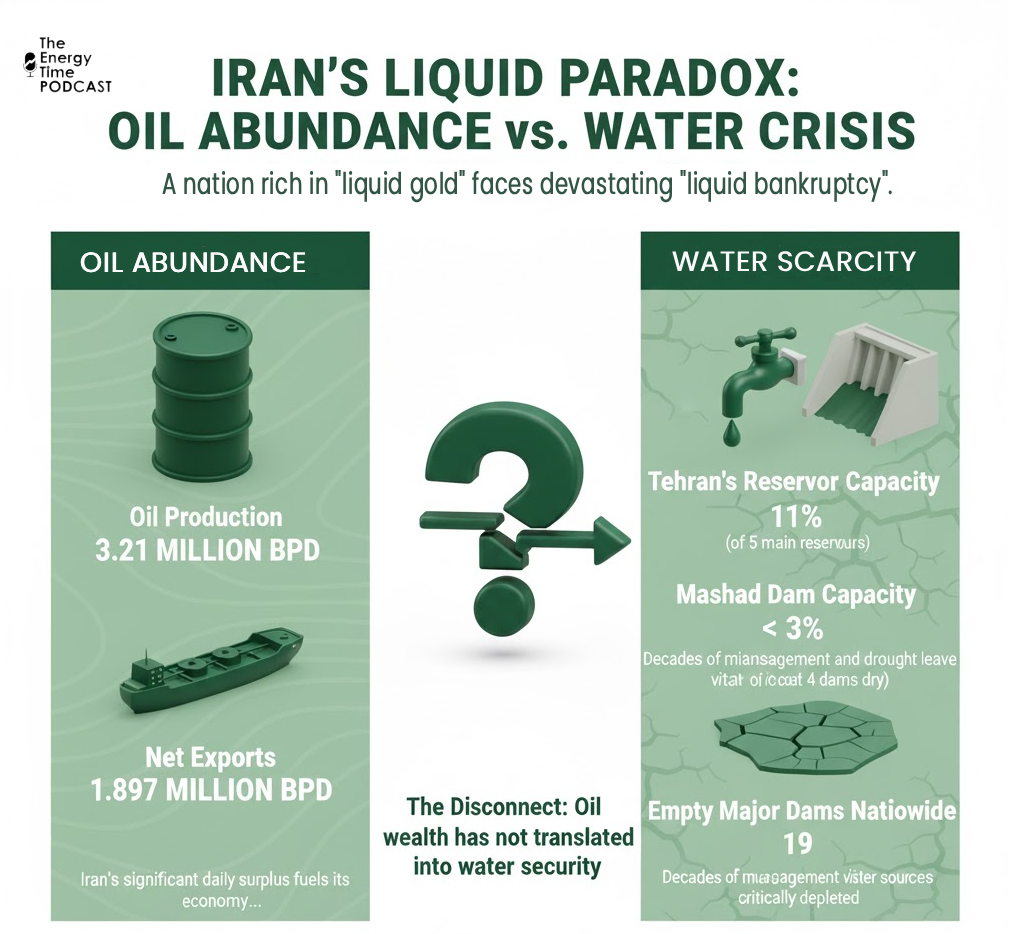
- Oil production: 3.21 million bpd
- Net exports: 1.897 million bpd
- Reservoir capacity: 11% ( Tehran’s five main reservoirs are currently holding just 11% of their total capacity)
- Mashhad dams: less than 3% capacity
- Empty major dams nationwide: 19
Iran’s water bankruptcy in pictures
![Water Bankruptcy in Iran: The depleted Amirkabir dam in Tehran, November 11 [Source Reuters]](https://theenergytime.com/wp-content/uploads/2025/11/The-depleted-Amirkabir-dam-in-Tehran-November-11-Source-Reuters.png)