
Nigeria’s electricity distribution companies recorded a sharp rise in income in the third quarter, even as power outages continued to disrupt daily life for millions of homes and businesses across Africa’s most populous country.
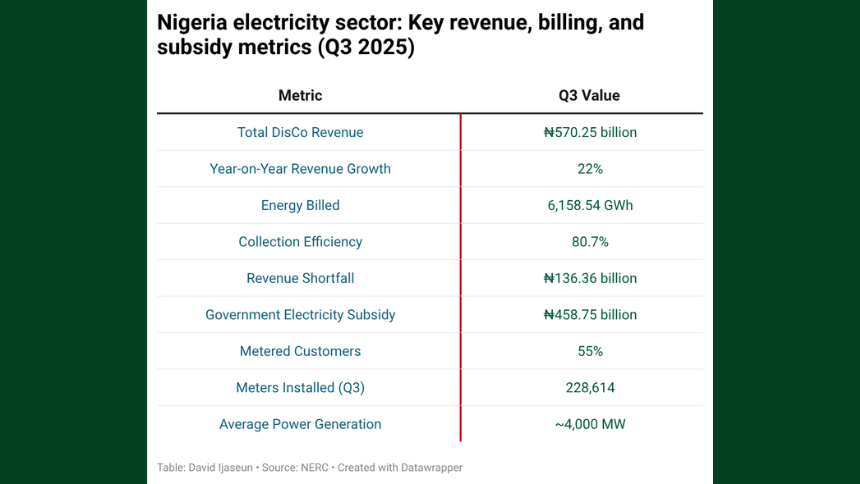
The 11 distribution companies earned a combined ₦570.25 billion during the quarter, up 22% from the same period last year, according to data released by the Nigerian Electricity Regulatory Commission on Tuesday.
The increase came despite a drop in the amount of electricity billed to customers. Energy billed fell to 6,158.54 gigawatt-hours, down from 6,449.82 GWh in the previous quarter, highlighting the growing gap between company revenues and actual power delivered.
Top Electricity Distribution Companies by Revenue
Ikeja Electric led the sector with ₦117.08 billion in collections, followed by Eko Electricity Distribution at ₦101.11 billion and Abuja Electricity Distribution with ₦90.73 billion.
At the other end of the scale, Yola, Kaduna, and Jos distribution companies recorded the lowest revenues, earning ₦9.24 billion, ₦12.28 billion, and ₦16.92 billion, respectively.


Collection Gaps, Meter Shortages, and Estimated Billing
Despite higher revenues, collection efficiency stood at 80.7%, leaving a ₦136.36 billion gap between what was billed and what customers actually paid.
Only 55% of Nigeria’s 12 million registered electricity customers have meters. Nearly half still rely on estimated billing, a practice consumer groups say often leads to inflated charges.
During the quarter, companies installed 228,614 meters, largely through the government-backed Meter Asset Provider program, a modest improvement from the previous period.
Electricity Subsidy and Fiscal Pressure
The revenue growth was driven mainly by recent tariff adjustments, not improved service. The government continued to shield consumers from full costs, spending ₦458.75 billion on electricity subsidy payments during the quarter.
The subsidy burden has become a major policy flashpoint as President Bola Tinubu’s administration faces mounting fiscal pressure after removing fuel subsidies last year.
Infrastructure Still the Core Problem
Energy analysts warn that higher revenues alone will not fix Nigeria’s power crisis without major investment in generation and transmission.
Nigeria generates about 4,000 megawatts for a population of over 200 million, far below what South Africa produces for just 60 million people. Frequent grid collapses and gas shortages have left many Nigerians dependent on diesel generators, raising costs for households and businesses alike.
Read also: Nigeria electricity market: What NERC’s Q3 2025 payment data reveals