
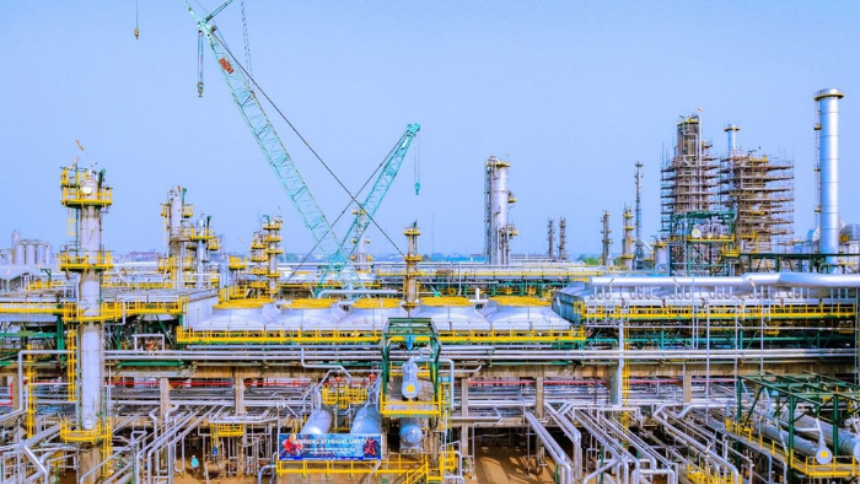
…Persistent Deficits and Future Prospects (Refinery) FROM January 2017 TO August (when NNPC stopped releasing monthly reports).
Nigeria’s four state-owned refineries, managed by the Nigerian National Petroleum Corporation, have consistently posted operating losses over the years. These refineries include the Warri Refining and Petrochemical Company (WRPC), the Kaduna Refining and Petrochemical Company (KRPC), and the two facilities that make up the Port Harcourt Refining Company (PHRC).
Despite a combined installed capacity of 445,000 barrels per day, these facilities have struggled to achieve profitability, raising concerns over their management and sustainability. This is expected to change since the NNPC recently announced the commencement of operation at the PHRC and WRPC.
Read also: Nigeria’s NNPC Sets 500,000 Barrels Per Day Refining Target
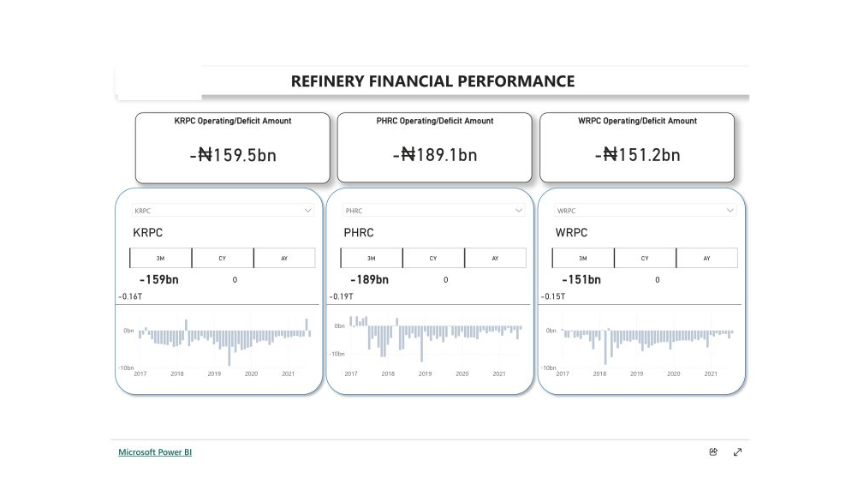


Persistent Deficits: A Trend Analysis
The refineries’ financial performance has remained in the red, with no recorded profits since 2017. A detailed analysis reveals consistent losses across all three refineries, with operating deficits peaking at different times.
Kaduna Refining and Petrochemical Company (KRPC):
The highest operating deficit was recorded in June 2019 at -9 billion Naira, followed by August 2019 at -5.9 billion Naira.
Notably, July 2021 recorded the least negative deficit of 3.2 billion Naira, which still reflected operational losses.
Kaduna Refinery’s financial statements for 2018 revealed zero revenue, an operating loss of 64.5 billion Naira, and significant direct costs amounting to 24 billion Naira. These expenses included 447.7 million Naira for training, 230 million Naira for security, and 843 million Naira for consultancy fees.
Port Harcourt Refining Company (PHRC):
PHRC’s highest operating deficit occurred in December 2018 at -12 billion Naira, with other significant losses of -11 billion Naira recorded in October and November 2017.
In 2018, the Port Harcout Refinery reported a gross loss of 22.58 billion Naira, stemming from total revenue of 1.45 billion Naira against expenses of 24.04 billion Naira.
Warri Refining and Petrochemical Company (WRPC):
WRPC’s worst performance came in March 2018, with a deficit of -9 billion Naira, followed by May 2018 with -7 billion Naira.
Despite recording revenue of 1.98 billion Naira in 2018, WRPC faced operating losses of 45.39 billion Naira due to high costs of sales and administrative expenses.
Examining Operational Challenges
Low Capacity Utilisation: None of the refineries operated at more than 50% of their installed capacity in 2017. For instance, the Warri refinery peaked at 42.6% in January, while the Port Harcourt refinery reached its highest utilisation of 41.7% in December.
Rising Operational Costs: Direct costs such as training, security, and consultancy significantly contribute to the operating deficits. For example, KRPC incurred costs of 24 billion Naira in 2018 despite generating no revenue.
Poor Management Practices: The refineries’ business model and operational inefficiencies have led to persistent losses. Efforts to adopt a merchant plant refineries business model since 2017 have yet to yield tangible results.
Future Prospects and Debates
The consistent losses raise fundamental questions about the sustainability of government-run refineries. Recent calls for privatization have gained traction, with critics arguing that the NNPC has failed to fulfill its mandate since its inception in 1977. During the 2019 general elections, Atiku Abubakar, a presidential candidate, advocated for the sale of the NNPC and its refineries to improve efficiency and reduce financial hemorrhage.
Conversely, NNPC’s current leadership has emphasized the need for improved management. Group Managing Director Mele Kyari has proposed revamping the refineries to enhance their operational capacity and efficiency. For instance, ongoing rehabilitation efforts in 2019 led to a slight improvement in the combined yield efficiency, which rose to 91.29% in May compared to zero in April that year.
Conclusion
Nigeria’s refineries have been consistent loss-makers, with no period of profitability since 2017. While rehabilitation and management reforms might offer short-term relief, the long-term solution could be adopting a private-sector-driven model. The need for transparency, operational efficiency, and sustainable business practices cannot be overstated if these assets are to contribute meaningfully to Nigeria’s economic growth.