
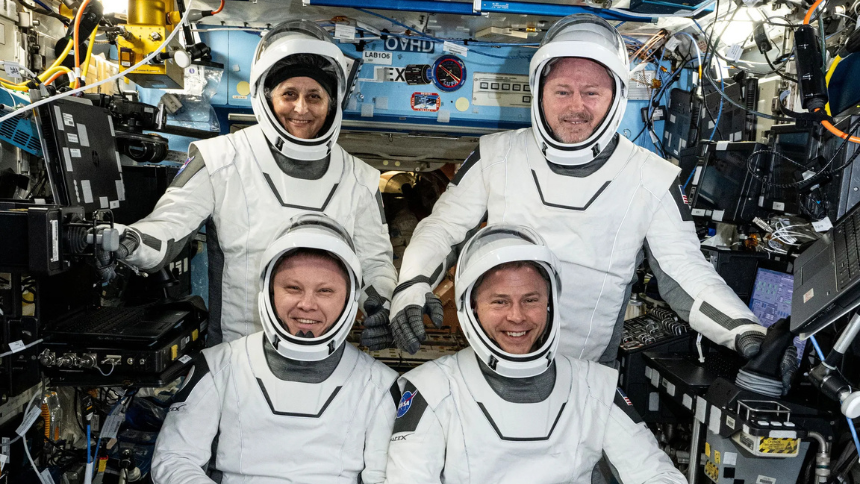
Four astronauts evacuated from the International Space Station (ISS) have safely returned to Earth, ending their mission one month early after a crew member fell seriously ill, marking an unprecedented moment in the station’s 26-year history.
The astronauts splashed down off the coast of California following a carefully managed return overseen by NASA, which confirmed the sick crew member is now stable and in good spirits.
Mission commander Mike Fincke was the first to exit the spacecraft, smiling as he stood briefly before lying on a gurney under standard post-flight procedures. He was followed by Nasa astronaut Zena Cardman, Japan’s Kimiya Yui, and Russian cosmonaut Oleg Platonov, all waving at cameras. “It’s so good to be home,” Cardman said.
NASA medical evacuation tests spaceflight health protocols


This marks the first medical evacuation from the ISS since it entered orbit in 1998. While astronauts are trained to handle minor health issues, the station has no doctor onboard, making medical emergencies one of the biggest risks of human spaceflight.
NASA administrator Jared Isaacman said the agency’s emergency response worked as planned. “The crew member is fine right now,” he said during a post-landing news conference.
The identity of the ill astronaut and details of the condition are unlikely to be disclosed, in line with past NASA health privacy practices.
Mission cut short after cancelled spacewalk
Crew-11 arrived at the ISS on August 1, expecting a standard six-and-a-half-month mission. The situation escalated last week when a scheduled spacewalk by Fincke and Cardman was abruptly cancelled. Hours later, NASA confirmed a crew member had become ill.
“It’s bittersweet,” Fincke said while handing over control of the ISS to Russian cosmonaut Sergey Kud-Sverchkov.
ISS left with skeleton crew
The early departure leaves the ISS with just three crew members until February: NASA’s Chris Williams and cosmonauts Kud-Sverchkov and Sergei Mikaev.
Despite the reduced staffing, Kud-Sverchkov said operations would continue. “We are going to do our job onboard ISS, whatever happens,” he said, before issuing his first command—a group hug.
What this means for future space travel
The ISS orbits Earth at 250 miles above the surface, traveling at 17,500 miles per hour and completing 16 orbits a day. It is operated by five space agencies and has been continuously occupied since 2000.
Space missions have ended early due to health issues only twice before, both during Soviet-era stations in 1985 and 1987.
As space tourism expands and future missions target the Moon and Mars, experts say this incident highlights a growing reality: doctors may need to travel alongside astronauts.
The evacuation proved NASA’s procedures work, but it also raised a critical question about how prepared humanity truly is for long-term life beyond Earth.