

Nigeria’s economy is facing a shift that could reshape its future. Crude oil exports, the country’s main revenue source, dropped by ₦3.18 trillion in the first half of 2025.
But the pain is being cushioned by fast-rising non-crude exports, from refined fuels to farm goods, according to new figures from the National Bureau of Statistics (NBS).
The NBS report shows crude exports fell to ₦24.92 trillion in H1 2025, down from ₦28.10 trillion a year earlier, an 11.3% decline in value. Quarter by quarter, exports dropped from ₦12.96 trillion in Q1 to ₦11.97 trillion in Q2. Oil’s share of Nigeria’s total exports shrank to 52.6% in Q2, from 71.2% in Q2 2024.
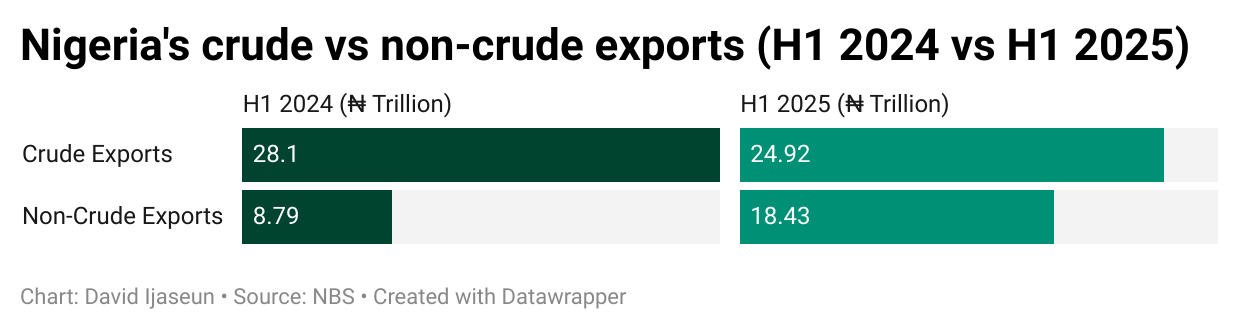
Yet there was good news. Non-crude exports more than doubled year-on-year, surging from ₦8.79 trillion in H1 2024 to ₦18.43 trillion in H1 2025. Agricultural products and solid minerals stayed above ₦3 trillion across both quarters, while refined petroleum products and semi-processed goods drove most of the gains. Non-crude exports now account for 41% of Nigeria’s total, up from just 24% last year.


Despite oil’s weakness, Nigeria recorded a trade surplus of ₦12.64 trillion in H1 2025, up 54.6% from ₦8.17 trillion a year earlier. Total exports hit ₦43.35 trillion, while imports stood at ₦30.71 trillion. Exports as a share of total trade rose to 59.8% in Q2 2025, compared with 55.9% in Q2 2024.
Nigeria still faces heavy pressure from fuel imports, which cost ₦4 trillion in H1 2025 alone. The country spent ₦2.3 trillion on fuel imports in Q2, after ₦1.76 trillion in Q1. For context, Nigeria spent ₦15.4 trillion on fuel imports in all of 2024. Analysts say the rising bill is a major drag on reserves and currency stability.
The International Energy Agency (IEA) has warned that OPEC’s ongoing production cuts may deepen the challenges for oil-reliant economies. “Developing countries like Nigeria will bear the brunt of tightening supply,” said the IEA.
Read also: Canada’s Oil Sands: Five things you need to know about world’s fourth-largest oil reserve