
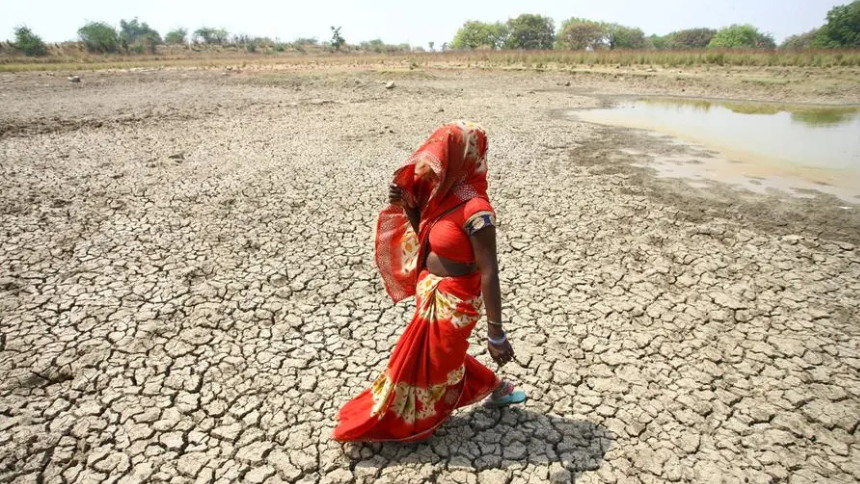
India’s $80 billion push to expand its coal-fired power infrastructure by 2031 is on a collision course with a worsening water crisis, threatening the country’s energy ambitions and the daily lives of millions.
Across drought-prone districts like Solapur and Chandrapur in Maharashtra, residents now wait up to a week for water, a far cry from the alternate-day supply just a decade ago. At the centre of this growing conflict is the Solapur thermal power station, a 1,320 MW coal plant commissioned by state-run NTPC in 2017, which draws heavily from the region’s limited water resources.
“We have 17% of the world’s population, but only 4% of its freshwater,” Shripad Dharmadhikary, an environmental researcher, said in a Reuters report. “Choosing to build more coal plants in already water-scarce regions risks deepening a national crisis.”
Water-stressed power expansion
Reuters reviewed a confidential Ministry of Power document that lists 44 new coal power projects. Of these, 37 are located in districts officially classified by the Indian government as water-stressed. NTPC, India’s largest power producer, is involved in nine projects and admitted to drawing 98.5% of its water from such regions.
NTPC told Reuters it is “continuously striving towards conservation of water,” noting the use of treatment and reuse methods at Solapur. But residents like Rajani Thoke feel the impact. “On supply days, I only store water and wash clothes. Everything else must wait,” she said.


Energy industry insiders interviewed for this story, ranging from federal groundwater board officials to power company executives, concurred: water access is rarely prioritised. Instead, land availability and low resistance from local populations dictate plant locations.
Solapur’s Lessons
Solapur’s story exemplifies the trade-offs India faces in its drive for industrialisation. The NTPC plant cost $1.34 billion to build and created thousands of jobs, but came at a social and environmental cost. Approved in 2008 despite the district being labelled “water scarce,” the project now competes with locals for water drawn from a reservoir 120 km away.
“We had nothing in Solapur in 2008,” said Sushilkumar Shinde, the former power minister who championed the plant. “The land acquisition helped locals earn. Mismanagement, not the plant, caused water shortages.”
Yet the plant’s inefficiencies are hard to ignore. According to government data, it’s among the least water-efficient in the country and runs at one of the lowest capacity utilisation rates. A state groundwater survey reveals that Solapur’s irrigation demand already exceeds its supply by 33%.
Coal vs Water
India has lost over 60 billion units of coal-power generation, equal to 19 days of nationwide supply, since 2014 due to water shortages. At Chandrapur Super Thermal Power Station, another water-stressed giant, units are regularly shut down during weak monsoons. Still, plans are underway to add 800 MW of capacity, even though no water source has been secured.
“There’s no guarantee of water,” said farmer Dharmes Waghmore. “How can I risk a loan for a bore well?”
The Ministry of Power declined to comment on these contradictions. Former top bureaucrat Ram Vinay Shahi defended coal’s dominance: “Between water and coal, preference is given to coal. It’s our only reliable energy source.”
But residents like Anjali in Chandrapur, who now depend on a tap outside the power station for drinking water, feel forgotten. “We’re poor, we make do with whatever we can get,” she said quietly.
India’s coal rush may fuel economic growth, but without addressing the water paradox, it could also drain the very lifeline millions depend on.
Solapur’s $80 billion push to expand its coal-fired power infrastructure by 2031 is on a collision course with a worsening water crisis
Read more on Britain Launches 81 criminal probes into water companies over sewage pollution