



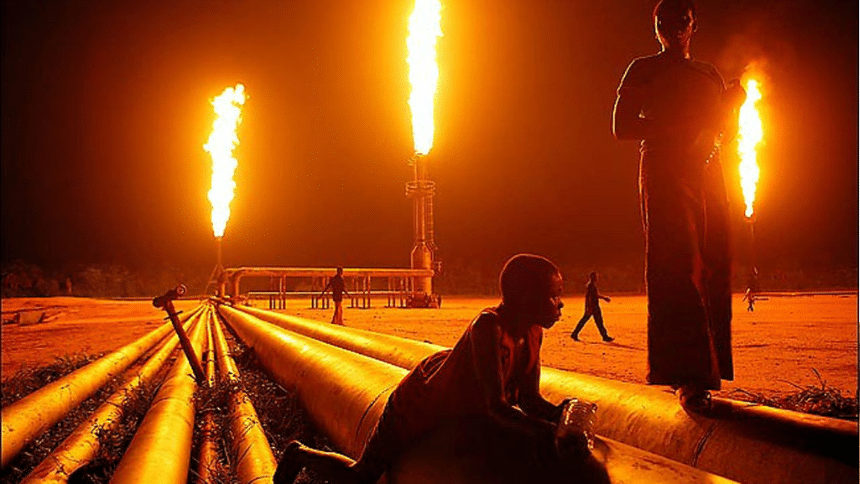
Gas flaring in Nigeria has climbed to a five-year high, raising doubts about the country’s ability to meet its own climate commitments. New government data shows that between January and May 2025, companies flared 154.1 million scf of gas, the highest in any five-month stretch since 2020. This continues a rising trend that saw flaring jump from 275.5 million scf in 2023 to 301.1 million scf in 2024.
Nigeria’s gas flaring has risen to a five-year high, threatening its pledge to cut emissions and reach net-zero by 2060, new government data shows. The spike has raised fresh concerns about the country’s climate goals, energy transition plans, and the performance of its oil and gas sector.
Data from the Nigerian Oil Spill Monitor, backed by the National Oil Spill Detection and Response Agency (NOSDRA), shows that oil and gas companies flared 154.1 million standard cubic feet (scf) of gas between January and May 2025. This is the highest five-month total since 2020 and signals a continuation of a worrying trend.
Nigeria made progress from 2018 to 2022, cutting flaring from 470.8 million scf to 224.9 million scf , a 52% drop. But flaring rose to 275.5 million scf in 2023 and 301.1 million scf in 2024. This marks a 15.7% increase from 2021, the year late President Muhammadu Buhari pledged at COP26 that Nigeria would reach net-zero by 2060.
Buhari’s pledge was welcomed globally, with an Energy Transition Plan (ETP) built on a “gas-based energy future” that would support growth while cutting pollution. But the recent rise in flaring suggests the transition is faltering.


“There’s been more crude oil production. Production normally comes with flaring,” said energy lawyer Ayodele Oni of Bloomfield Law Practice. “The more production, the more flare you have, unfortunately.”
Regulators say the problem stems from weak pipelines, low gas-processing capacity and limited commercial buyers. Economists estimate the losses — from wasted gas, lost power supply and missed export revenue — at tens of billions of dollars.
The government has rolled out several programmes, including the Nigerian Gas Flare Commercialisation Programme (NGFCP), relaunched in 2023 to attract investors to capture and convert flared gas. The Nigerian Upstream Petroleum Regulatory Commission (NUPRC) has also launched a decarbonisation blueprint with the World Bank to track emissions and cut methane.
“Methane emissions account for a significant share of Nigeria’s upstream footprint,” said NUPRC’s Enorense Amadasu. “Flaring, venting and leaks remain major sources.”
Last week, Minister of State for Petroleum Resources (Gas), Ekperikpe Ekpo, said Nigeria is enforcing flare-out deadlines under the Petroleum Industry Act and expanding monitoring with satellites, drones and handheld sensors. “These tools will provide real-time data and reduce environmental harm,” he said.
Private firms are also entering the space. PE Energy has launched modular gas units for marginal fields, while TotalEnergies says it has achieved zero routine flaring in its Nigerian operations ahead of schedule using drone-based monitoring.
But despite new policies and partnerships, Nigeria’s flare-out goal remains at risk. “All these penalties don’t stop flaring,” Oni said. “The answer is supporting gas commercialisation and getting more investors involved.”
Read more on BREAKING: NNPC reports ₦5.4tn profit after tax, unveils $60bn growth plan to 2030
![The Australian Immi App [file Uniway Australia]](https://theenergytime.com/wp-content/uploads/2025/12/The-Australian-Immi-App-file-Uniway-Australia-150x150.png)
![The Trump administration environmental rollback [file Brookings Institution]](https://theenergytime.com/wp-content/uploads/2025/12/The-Trump-administration-file-Brookings-Institution-150x150.png)