
Natural disasters are leaving deeper scars on lives, economies, and industries worldwide. A new report from Munich Re, one of the world’s largest reinsurers, shows that in just the first six months of 2025, global losses from natural disasters climbed to $131 billion.
This is lower than the $155 billion recorded during the same period in 2024 but still alarmingly higher than historical averages. For perspective, the 30-year average for first-half losses sits at $79 billion, meaning 2025’s disasters have already cost nearly 70% more than what was typical three decades ago.
The numbers underscore a simple truth: the financial toll of climate-driven disasters is rising, and so are the risks for ordinary people and businesses.
Disaster costs stay stubbornly high
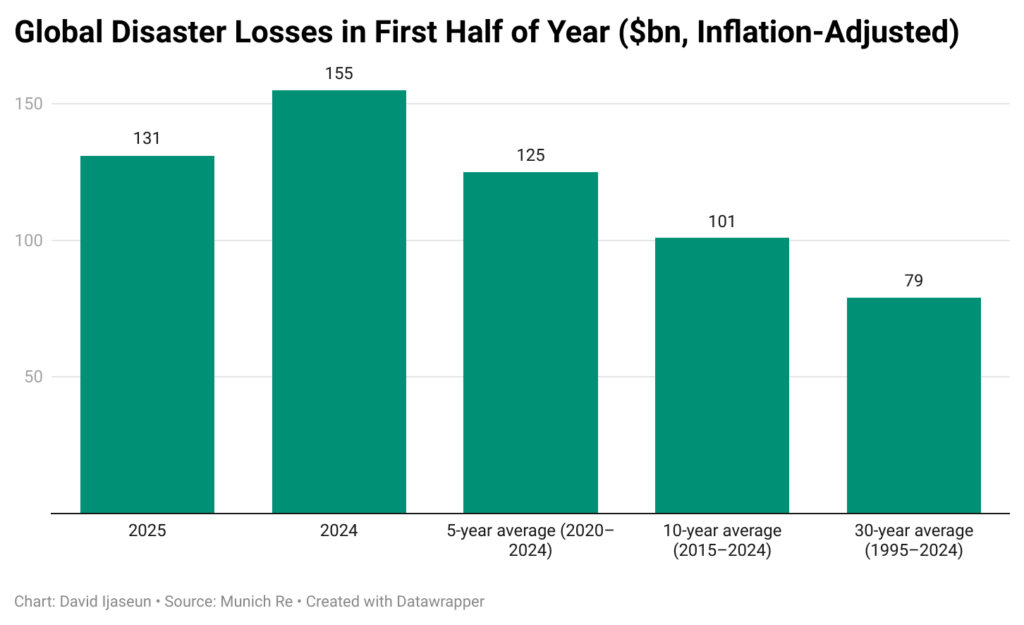
Even though losses dropped slightly compared to 2024, the $131 billion figure dwarfs past averages. From 2020–2024, the five-year first-half average was $125 billion. Go back ten years, and the figure falls to $101 billion. The fact that 2025 is still above both marks shows a troubling trend: natural disasters are no longer rare, billion-dollar events—they are a new normal.


“We need to face it that the losses have been on the rise and make it clear that climate change plays an ever-increasing role,” said Tobias Grimm, Munich Re’s chief climate scientist.
Insurance industry faces soaring payouts
Out of the $131 billion in damages, insurers covered $80 billion, making 2025 the second costliest first half on record in terms of insured payouts. The only higher figure came in 2011, following Japan’s devastating earthquake and tsunami.
This surge in insured claims poses a critical question: how long can insurance companies absorb such costs without passing the burden on to policyholders? Munich Re and other insurers warn that higher premiums, stricter policy terms, and even coverage exclusions are likely for homes, cars, and businesses in high-risk areas.
Los Angeles wildfires are the costliest event of 2025 so far
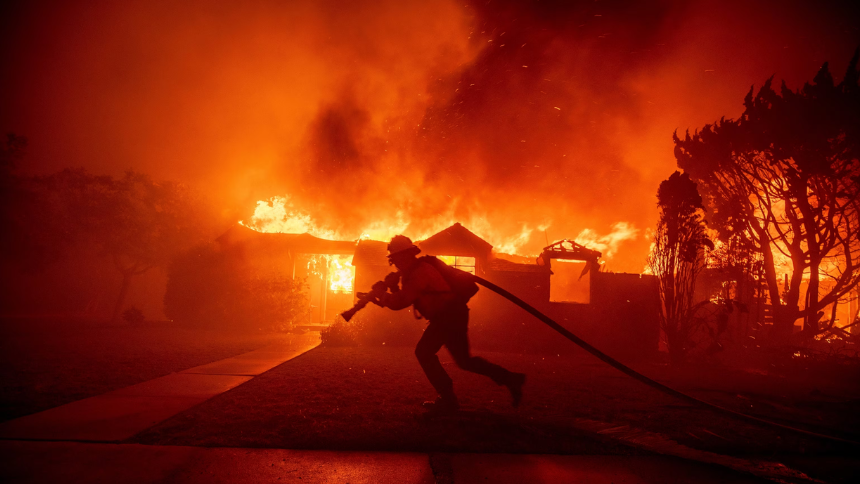
The year’s most expensive disaster so far has been the Palisades and Eaton wildfires in California, which alone caused $53 billion in damages. Insurers covered about $40 billion, making the fires not only the costliest event of 2025 but also one of the most expensive disasters in modern history.
Scientists say climate change intensified the fires. Warmer temperatures and drier conditions raised the fire weather index, allowing flames to spread faster and burn longer. The disaster forced thousands to evacuate and destroyed entire neighborhoods, highlighting how quickly an urban area can be consumed by climate-fueled events.
Earthquakes still deadly, but poorly insured
On March 28, a 7.7-magnitude earthquake struck Myanmar and neighbouring regions, killing at least 4,500 people and causing $12 billion in damage. Yet only $700 million was insured.
The gap between insured and uninsured losses underscores a persistent inequality: poorer regions suffer the same or greater devastation but lack the insurance safety nets available in wealthier countries. This leaves survivors dependent on international aid and local government relief, which often falls short.
Storms and wildfires dominate global disaster costs
Munich Re’s report found that 88% of total losses this year came from weather-related disasters such as storms, floods, and fires. When it comes to insured losses, that figure rises to 98%, leaving only 2% linked to earthquakes and other geophysical events.
In the U.S. alone, several storm systems caused more than $19 billion in damages, much of it from tornadoes and flash floods. Insurance covered about $14.6 billion of that, but for families who lost homes or farms, recovery has been slow.
“Usually the second half of the year is more costly,” Grimm warned, pointing to the Atlantic hurricane season, which peaks between August and November.
Why it matters: Costs will filter down to you
The financial ripple effect of disasters is felt far beyond the disaster zones. Rising claims push up insurance premiums for homeowners, drivers, and businesses worldwide. Automakers, for example, face disrupted supply chains when factories or ports are damaged. Consumers, in turn, pay more for vehicles, repairs, and insurance coverage.
Thomas Blunck, a member of Munich Re’s Board of Management, warned: “The best way to avoid losses is to implement effective preventive measures, such as more robust construction for buildings and infrastructure. Such precautions can help maintain reasonable insurance premiums, even in high-risk areas. Most importantly: to reduce future exposure, new building development should not be allowed in high-risk areas.”
Without adaptation, experts fear disaster costs will keep climbing, pushing insurance out of reach for many and leaving vulnerable communities exposed.
Read also: Climate change: Europe is battling its deadliest wildfires yet