Canada’s oil sands are not just piles of sand soaked in oil. They are a vast, complex resource that fuels economies, pays for schools and hospitals, and connects Canada to the global energy system. They are also controversial, because while they create jobs and wealth, they also raise questions about cost, the environment, and the future of energy in a world trying to move toward cleaner fuels.
Here are five things you should know that explain why Canada’s oil sands matter to you, to Canada, and to the world.
1. Canada holds the world’s fourth-largest oil reserves
At their core, Canada’s oil sands are a mixture of sand, clay, water, and bitumen, a thick, heavy type of crude oil. Bitumen is sticky and difficult to extract, but once separated and upgraded, it can be refined into gasoline, diesel, and jet fuel that power daily life.
These oil sands hold 159 billion barrels of proven oil, making up about 98% of Canada’s total reserves. This puts Canada in fourth place globally, behind Venezuela, Saudi Arabia, and Iran.


In 2024, the oil sands alone produced 3.5 million barrels per day, almost enough to meet the entire daily demand of countries like Japan or India. That scale makes Canada a crucial energy player.
2. Oil sands development fuels Canada’s economy and global markets
The story of Canada’s oil sands is also a story of money, jobs, and opportunity. Since development began, companies have poured C$366 billion in investment into the sector, with $12.4 billion spent in 2023 alone. That money does not just stay in Alberta, where the sands are located. It ripples outward, supporting construction workers, engineers, service providers, and even technology firms across the country.
The impact stretches around the world. Major investors from the United States, Europe, and Asia have put money into oil sands projects, betting on Canada as a stable and reliable energy partner. Every dollar spent in the sands ties Canada’s economy to the wider global market, reinforcing its role as one of the world’s trusted oil suppliers.
For ordinary Canadians, this means secure paychecks, stronger communities, and government revenue that supports social programs. In this way, the oil sands are not just an energy resource. They are a lifeline for families and towns across the nation.
3. New technology has transformed the oil sands into low-cost energy giants
A decade ago, the oil sands had a reputation for being slow, costly, and unattractive. After the oil price crash of 2014–15, several international giants, including BP, Chevron, and Total, sold off their oil sands projects, saying the operations were too expensive compared to other options like U.S. shale oil.
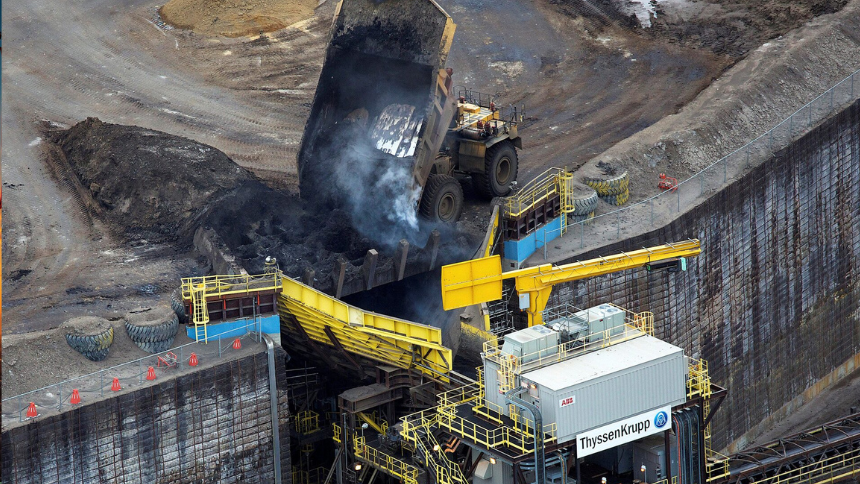
But that picture has changed dramatically. Through a mix of heavy investment, engineering breakthroughs, and sheer determination, Canada’s oil sands producers have cut costs and boosted efficiency. Companies like Imperial Oil and Suncor now rely on giant shovels, driverless trucks, and even robotic dogs to keep operations running smoothly.
At Imperial Oil’s Cold Lake site, two robot dogs, each called “Spot”, patrol the massive facility. They check equipment, monitor oil-water tanks, and optimise heat exchangers. These robotic helpers save the company C$30 million every year, freeing human workers for other jobs. At the Kearl mine, Imperial has seen output rise by 20% since 2023, thanks to autonomous vehicles.
These changes mean costs are lower than ever. The break-even cost for oil sands is now between $40 and $43 per barrel. In comparison, U.S. shale producers need oil prices closer to $65 per barrel to stay profitable. This has turned the oil sands into one of North America’s lowest-cost sources of crude oil.
4. Oil sands projects last for decades, while Shale wells run dry quickly
Another reason the oil sands are so powerful is their long life. Starting an oil sands project requires big upfront costs, because the work often looks more like mining than traditional drilling. But once a mine is running, it can produce oil for decades with very little decline.
For example, Canadian Natural Resources’ Horizon mine has been operating since 2009. It still has enough reserves to keep producing for 43 more years. That kind of stability is rare in the oil business. It allows companies to plan long-term, governments to count on steady revenue, and workers to have lasting jobs.
U.S. shale, by contrast, works differently. Shale wells are cheaper to start, but their production drops fast — sometimes within months. To keep output steady, drillers must constantly open new wells, driving up costs over time. This constant churn makes shale more vulnerable to price swings and inflation.
Investors are noticing the difference. As one portfolio manager, Kevin Burkett, put it: “(Canada’s oil sands) are not geopolitically risky, and they have some very appealing characteristics around productivity and costs.” His words capture why many investors now see Canada’s oil sands as a safer, steadier long-term bet compared to shale.
5. Stronger balance sheets and cleaner technology signal a bright future
The oil sands are not only producing more oil at lower costs. They are also cleaning up their finances and preparing for the future. Between 2021 and 2024, Canada’s five biggest producers, Canadian Natural Resources, Suncor, Cenovus, Imperial Oil, and MEG Energy, paid off nearly C$22 billion in debt. Their combined net debt now stands at C$33.9 billion, which is far healthier than before.
This financial strength allows companies to shift focus. Instead of pouring money into paying off loans, they can reward shareholders through dividends and buybacks, making the oil sands an attractive investment. At the same time, companies are putting more effort into reducing emissions and cutting the environmental footprint of oil sands development.
The Canadian government, through Natural Resources Canada (NRCan), is also pushing for cleaner and smarter development. It funds research into new extraction methods, supports innovation, and helps companies test technologies that reduce water use, energy waste, and greenhouse gases. From robotic inspections to better maintenance systems, the oil sands are becoming more efficient and less damaging.
Read also Strait of Hormuz: Eight vital facts behind the world’s oil lifeline now at risk
![Cenovus to Buy MEG Canada's Oil Sands [Discovery Alert]](https://theenergytime.com/wp-content/uploads/2025/08/Cenovus-to-Buy-MEG-Canadas-Oil-Sands-Discovery-Alert--150x150.png)