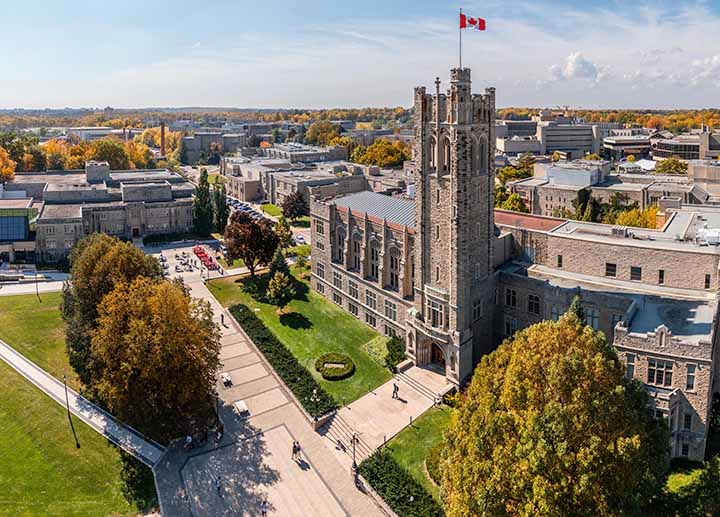
Western University in Canada is considering working with Navitas, a private education company from Australia, to set up a new international college. The goal is to attract more international students and help compensate for lost revenue caused by fewer students and limited government funding.
The proposed agreement has passed a narrow vote in the university Senate in Canada and now awaits final approval from the Board of Governors.
According to reporting by CBC News, the initiative involves the formation of “Western International College” (WIC), a separate, privately operated college that would serve as an entry point for some international students not meeting standard admission requirements.
Separate College Model Proposed
Reports inform that the proposed WIC would admit international students—primarily those lacking prerequisites unavailable in their home countries—into a separate first-year program. A stream for international master’s students is also included in the proposal. Students would attend classes at a separate location, possibly the former Brescia University College campus.


Students in WIC would pay the same tuition as other international students. Tuition fees would be paid directly to WIC, with Western receiving a portion as a royalty. Furthermore, students would only be eligible to transition into second-year programs at Western if they meet the specified academic requirements. The university would retain control over academic staff hiring and oversight of academic quality at WIC.
Concerns Over Privatisation and Academic Pressure
It has been revealed that Western faculty have raised concerns about the implications of involving a private company in university programming. Johanna Weststar, president of the University of Western Ontario Faculty Association, Canada, told CBC News that the proposal raises concerns about academic integrity and institutional independence.
“It’s concerning because it is a model of privatisation,” said Weststar.
“Navitas runs a lean company because they want to maximise profits, which complicates things when you bring that into a public sector system.”
She also warned that faculty at WIC may face pressure to pass underqualified students to preserve revenue flows. “It will put a lot of pressure on the faculty members who teach those courses to progress those students,” she said.
Enrollment Strategy Tied to Financial Gaps
Western’s internal submission to the Senate stated that the university has lost $40 million in revenue due to a drop of 780 international students since 2021. A stated goal is to raise international enrollment from 7.5% to 20%, bringing Western in line with peer institutions. Previous attempts to increase recruitment through internal spending, including a $5.5 million initiative, were considered insufficient.
The university believes working with Navitas could provide access to a recruitment network without significant upfront costs. Projected revenue from the partnership is estimated at $73.5 million by the 2032–35 academic years.
The deal could also allow Westerners to access more “provincial attestation letters” (PALs), which international students need to receive for federal study permits. Western’s Senate submission states that other Ontario universities in similar partnerships have received additional PAL allocations from the province.
Mixed Reactions from Politicians and Education Experts
Reports cite that London West MPP and NDP education critic Peggy Sattler has publicly opposed the partnership.
“What Navitas does is privatise a first-year university program in the interest of the shareholders of the for-profit corporation,” she said.
However, Sattler also said the root problem is provincial underfunding of universities, which forces institutions to seek private alternatives.
Maïca Murphy, a research manager at Higher Education Strategy Associates, said these types of partnerships appeal to universities facing budget constraints.
“It’s a low-risk alternative revenue stream for institutions,” she told CBC.
Murphy noted that international student tuition has helped sustain university budgets for over a decade, during limited government investment and rising domestic enrollment.
Western previously considered a deal with Navitas in 2020 but declined. This time, university officials say the agreement includes more control over operations and academic oversight.
Western is one of several Canadian universities exploring or using the Navitas model. Others include Toronto Metropolitan University, Wilfrid Laurier University, the University of Manitoba, and Simon Fraser University.